When Jim Reeves released “He’ll Have to Go” in late 1959, no one could have predicted just how deeply the song would resonate with listeners. But as 1960 began, the soft, velvet-smooth vocals of Reeves began pouring out of radios across America, capturing the attention of millions.
It wasn’t just a country song; it was a moment, a mood, and a masterpiece that transcended genres. Reeves’ elegant delivery, paired with its haunting melody, gave the world one of the most iconic heartbreak songs of all time — one that would change the landscape of country and pop music in a way few songs ever have.
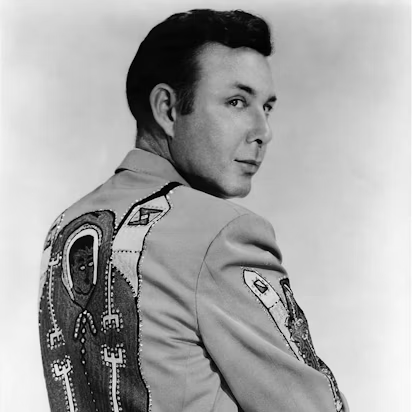
Jim Reeves had always been admired for his warm tone and gentlemanly presence, earning him the nickname “Gentleman Jim.” But this song elevated him to an entirely different level of artistry.
Listeners instantly felt the emotional intimacy in his performance, as if he were speaking directly to them from a dimly lit room. The calm sadness in his voice and the soft orchestration wrapped the song in an atmosphere of longing, vulnerability, and quiet desperation. It was this emotional connection — simple yet profound — that made the track so universally relatable.
A Song Born from Real-Life Emotion
The story behind “He’ll Have to Go” is as compelling as the song itself. Written by Joe and Audrey Allison, the lyrics emerged from a moment Joe overheard at a bar: a man pleading with a woman over the phone, asking her to speak closer so he could hear her voice.
There was something heartbreakingly human about that exchange — a man trying to hold on to someone who was slipping away. That raw mixture of love, fear, and tenderness became the soul of the song. Joe and Audrey turned that brief emotional glimpse into a lyrical masterpiece about longing, distance, and the aching hope that love might still survive.
When Jim Reeves stepped into the studio to record it, he didn’t merely perform the song — he embodied it. Under the subtle musical direction of Chet Atkins, one of the pioneers of the Nashville Sound, the arrangement was kept intentionally minimal.
Atkins believed that Reeves’ voice could carry the emotional weight on its own, and he was absolutely right. The instrumentation stayed smooth and understated, providing just enough texture to enhance the vocals without overwhelming them.
A Career-Defining Moment for Jim Reeves
By the time he recorded this song, Reeves was already respected within country music. But “He’ll Have to Go” did something remarkable: it introduced him to an entirely new audience and solidified his reputation as one of the greatest storytellers in music.
His background as a radio announcer had trained him to use his voice with precision — soft when needed, strong when required, and always emotionally resonant. His vocal control allowed him to deliver heartache not through dramatic outbursts but through quiet sincerity, and that subtlety became his signature.
The song’s lyrical perspective — a man asking his lover to let another man go — was intimate and honest. Reeves sang those lines with a vulnerability that felt deeply personal. People recognized themselves in the pain he expressed.
It was a song about wanting to be loved, fearing rejection, and hoping for reassurance. These themes were universal, and listeners from all walks of life found a piece of their own story in the lyrics.
A Chart Phenomenon That Crossed Genres
When “He’ll Have to Go” reached radio stations in 1959 and early 1960, the response was immediate and overwhelming. The song quickly rose to the top of the Billboard Country Chart, holding the #1 spot for an extraordinary 14 weeks.
This kind of dominance was rare, especially in a genre still struggling for mainstream recognition. But what truly shocked the industry was the song’s success beyond country audiences.
“He’ll Have to Go” climbed all the way to #2 on the Billboard Hot 100, something few country songs had ever accomplished at the time. It didn’t just cross over — it flourished. This achievement proved that the softer, more polished “Nashville Sound” had broad appeal.
Reeves’ smooth baritone attracted listeners who normally preferred pop or easy-listening genres, bridging musical worlds that had long been separated.
Reinventing the Sound of Nashville
Music historians often point to “He’ll Have to Go” as a milestone in the development of the Nashville Sound. This new approach aimed to create country music that was more accessible, polished, and radio-friendly.
Traditional country elements were softened, replaced by orchestral arrangements, gentle rhythms, and rich vocal harmonies. Jim Reeves became one of the major architects of this movement.
The success of the song demonstrated that country music could be sophisticated without losing its emotional depth. It could be polished without becoming artificial. Reeves showed that authenticity didn’t require twang or rough edges — it could be expressed through elegance, restraint, and emotional honesty.
This opened the door for future artists to experiment with crossover styles, blending country with pop influences while keeping the heart of the genre intact.
A Song That Became a Cultural Touchstone
“He’ll Have to Go” didn’t just succeed commercially — it became a cultural phenomenon. Couples slow-danced to it in living rooms and honky-tonks. Soldiers overseas requested it on the radio to feel closer to loved ones back home.
DJs played it on late-night shows, knowing it would resonate with anyone who had ever experienced love slipping through their fingers. The song became part of countless personal stories: breakups, reconciliations, heartaches, and hopeful phone calls.
The simplicity of the lyrics and the warmth of Reeves’ voice made it ageless. It captured emotions that are timeless — longing, heartbreak, and the yearning for closeness. Unlike many songs of the era, its message has not faded with time.
Modern listeners still feel its power, proving that human emotion never goes out of style.
Global Impact and Artistic Influence
Jim Reeves’ success with this song catapulted him onto the international stage. He toured worldwide, introducing country music to audiences who had never heard anything like it. His polished tone and gentlemanly demeanor made him an ambassador for the genre, expanding its reach far beyond the American South.
The song inspired countless cover versions. Elvis Presley recorded his own rendition, adding a touch of rock-and-roll intensity. Ry Cooder produced a haunting interpretation years later.
Many artists tried to capture the magic Reeves brought to the track, but none came close to matching the original. Reeves’ version remains the gold standard — the one listeners still return to after all these decades.
A Life Cut Short Too Soon
Tragedy struck in 1964 when Jim Reeves died in a plane crash at just 40 years old. His death sent shockwaves through the music industry.
He had been one of Nashville’s brightest stars, a visionary who was just beginning to shape the future of country music. His passing left an irreplaceable void, but the music he left behind continued to grow in influence.
Reeves was posthumously inducted into the Country Music Hall of Fame, a recognition of his extraordinary contributions to the genre. But his greatest legacy remains “He’ll Have to Go,” a song that continues to breathe life into his memory every time it plays.
A Timeless Classic That Still Resonates
More than six decades after its release, “He’ll Have to Go” remains one of the most cherished songs in both country and pop history. It is featured in films, TV shows, documentaries, and commercials.
Younger generations discover it and fall in love with its simplicity. Older generations revisit it for nostalgia and comfort. The song’s emotional depth is undiminished, its message as relatable today as it was in 1960.
Jim Reeves showed the world that music doesn’t need complexity to be powerful. Sometimes all it takes is a gentle voice, a sincere emotion, and a beautifully written melody.
His influence is still felt in the work of artists who successfully bridge country and pop — from Shania Twain to Keith Urban to Taylor Swift. They all owe something to the path Reeves forged.
A Musical Legacy That Will Never Fade
In the end, “He’ll Have to Go” wasn’t just a chart-topping hit. It was a turning point in American music — a song that united genres, touched millions, and shaped the sound of modern country.
It stands as a testament to Jim Reeves’ ability to capture universal emotion with unmatched grace and sincerity. As long as people experience love, longing, and heartbreak, this song will continue to speak to them.
Jim Reeves may be gone, but his voice lives on. And with it, the timeless magic of “He’ll Have to Go.”
When Jim Reeves released “He’ll Have to Go” in late 1959, no one could have predicted just how deeply the song would resonate with listeners. But as 1960 began, the soft, velvet-smooth vocals of Reeves began pouring out of radios across America, capturing the attention of millions.
It wasn’t just a country song; it was a moment, a mood, and a masterpiece that transcended genres. Reeves’ elegant delivery, paired with its haunting melody, gave the world one of the most iconic heartbreak songs of all time — one that would change the landscape of country and pop music in a way few songs ever have.
Jim Reeves had always been admired for his warm tone and gentlemanly presence, earning him the nickname “Gentleman Jim.” But this song elevated him to an entirely different level of artistry.
Listeners instantly felt the emotional intimacy in his performance, as if he were speaking directly to them from a dimly lit room. The calm sadness in his voice and the soft orchestration wrapped the song in an atmosphere of longing, vulnerability, and quiet desperation. It was this emotional connection — simple yet profound — that made the track so universally relatable.
A Song Born from Real-Life Emotion
The story behind “He’ll Have to Go” is as compelling as the song itself. Written by Joe and Audrey Allison, the lyrics emerged from a moment Joe overheard at a bar: a man pleading with a woman over the phone, asking her to speak closer so he could hear her voice.
There was something heartbreakingly human about that exchange — a man trying to hold on to someone who was slipping away. That raw mixture of love, fear, and tenderness became the soul of the song. Joe and Audrey turned that brief emotional glimpse into a lyrical masterpiece about longing, distance, and the aching hope that love might still survive.
When Jim Reeves stepped into the studio to record it, he didn’t merely perform the song — he embodied it. Under the subtle musical direction of Chet Atkins, one of the pioneers of the Nashville Sound, the arrangement was kept intentionally minimal.
Atkins believed that Reeves’ voice could carry the emotional weight on its own, and he was absolutely right. The instrumentation stayed smooth and understated, providing just enough texture to enhance the vocals without overwhelming them.
A Career-Defining Moment for Jim Reeves
By the time he recorded this song, Reeves was already respected within country music. But “He’ll Have to Go” did something remarkable: it introduced him to an entirely new audience and solidified his reputation as one of the greatest storytellers in music.
His background as a radio announcer had trained him to use his voice with precision — soft when needed, strong when required, and always emotionally resonant. His vocal control allowed him to deliver heartache not through dramatic outbursts but through quiet sincerity, and that subtlety became his signature.
The song’s lyrical perspective — a man asking his lover to let another man go — was intimate and honest. Reeves sang those lines with a vulnerability that felt deeply personal. People recognized themselves in the pain he expressed.
It was a song about wanting to be loved, fearing rejection, and hoping for reassurance. These themes were universal, and listeners from all walks of life found a piece of their own story in the lyrics.
A Chart Phenomenon That Crossed Genres
When “He’ll Have to Go” reached radio stations in 1959 and early 1960, the response was immediate and overwhelming. The song quickly rose to the top of the Billboard Country Chart, holding the #1 spot for an extraordinary 14 weeks.
This kind of dominance was rare, especially in a genre still struggling for mainstream recognition. But what truly shocked the industry was the song’s success beyond country audiences.
“He’ll Have to Go” climbed all the way to #2 on the Billboard Hot 100, something few country songs had ever accomplished at the time. It didn’t just cross over — it flourished. This achievement proved that the softer, more polished “Nashville Sound” had broad appeal.
Reeves’ smooth baritone attracted listeners who normally preferred pop or easy-listening genres, bridging musical worlds that had long been separated.
Reinventing the Sound of Nashville
Music historians often point to “He’ll Have to Go” as a milestone in the development of the Nashville Sound. This new approach aimed to create country music that was more accessible, polished, and radio-friendly.
Traditional country elements were softened, replaced by orchestral arrangements, gentle rhythms, and rich vocal harmonies. Jim Reeves became one of the major architects of this movement.
The success of the song demonstrated that country music could be sophisticated without losing its emotional depth. It could be polished without becoming artificial. Reeves showed that authenticity didn’t require twang or rough edges — it could be expressed through elegance, restraint, and emotional honesty.
This opened the door for future artists to experiment with crossover styles, blending country with pop influences while keeping the heart of the genre intact.
A Song That Became a Cultural Touchstone
“He’ll Have to Go” didn’t just succeed commercially — it became a cultural phenomenon. Couples slow-danced to it in living rooms and honky-tonks. Soldiers overseas requested it on the radio to feel closer to loved ones back home.
DJs played it on late-night shows, knowing it would resonate with anyone who had ever experienced love slipping through their fingers. The song became part of countless personal stories: breakups, reconciliations, heartaches, and hopeful phone calls.
The simplicity of the lyrics and the warmth of Reeves’ voice made it ageless. It captured emotions that are timeless — longing, heartbreak, and the yearning for closeness. Unlike many songs of the era, its message has not faded with time.
Modern listeners still feel its power, proving that human emotion never goes out of style.
Global Impact and Artistic Influence
Jim Reeves’ success with this song catapulted him onto the international stage. He toured worldwide, introducing country music to audiences who had never heard anything like it. His polished tone and gentlemanly demeanor made him an ambassador for the genre, expanding its reach far beyond the American South.
The song inspired countless cover versions. Elvis Presley recorded his own rendition, adding a touch of rock-and-roll intensity. Ry Cooder produced a haunting interpretation years later.
Many artists tried to capture the magic Reeves brought to the track, but none came close to matching the original. Reeves’ version remains the gold standard — the one listeners still return to after all these decades.
A Life Cut Short Too Soon
Tragedy struck in 1964 when Jim Reeves died in a plane crash at just 40 years old. His death sent shockwaves through the music industry.
He had been one of Nashville’s brightest stars, a visionary who was just beginning to shape the future of country music. His passing left an irreplaceable void, but the music he left behind continued to grow in influence.
Reeves was posthumously inducted into the Country Music Hall of Fame, a recognition of his extraordinary contributions to the genre. But his greatest legacy remains “He’ll Have to Go,” a song that continues to breathe life into his memory every time it plays.
A Timeless Classic That Still Resonates
More than six decades after its release, “He’ll Have to Go” remains one of the most cherished songs in both country and pop history. It is featured in films, TV shows, documentaries, and commercials.
Younger generations discover it and fall in love with its simplicity. Older generations revisit it for nostalgia and comfort. The song’s emotional depth is undiminished, its message as relatable today as it was in 1960.
Jim Reeves showed the world that music doesn’t need complexity to be powerful. Sometimes all it takes is a gentle voice, a sincere emotion, and a beautifully written melody.
His influence is still felt in the work of artists who successfully bridge country and pop — from Shania Twain to Keith Urban to Taylor Swift. They all owe something to the path Reeves forged.
A Musical Legacy That Will Never Fade
In the end, “He’ll Have to Go” wasn’t just a chart-topping hit. It was a turning point in American music — a song that united genres, touched millions, and shaped the sound of modern country.
It stands as a testament to Jim Reeves’ ability to capture universal emotion with unmatched grace and sincerity. As long as people experience love, longing, and heartbreak, this song will continue to speak to them.
Jim Reeves may be gone, but his voice lives on. And with it, the timeless magic of “He’ll Have to Go.”