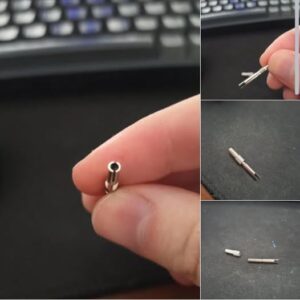
Bet You Don’t Know What This Tiny Metal Object Is
At first glance, it looks like a random piece of metal—small, silver, and oddly shaped with two prongs that don’t seem to belong to anything familiar. Many people who come across it assume it’s part of a bike, a gadget, or even a broken tool from some unknown device.
That’s exactly what happened when a parent recently found one of these mysterious objects. It didn’t resemble anything obvious, and its purpose wasn’t immediately clear. It looked too small to be important, too specific to be random—but still completely unrecognizable.
After a bit of digging and curiosity, the truth came out.
This tiny, overlooked object turned out to be something most of us have used at some point in our lives—but likely forgot about entirely.
It was a compass lead holder.
Yes, that small metal piece once played a crucial role in the geometry sets many students carried to school. Despite its importance, it’s also one of the most commonly lost—and least remembered—items from those kits.
The Forgotten Essential From Every Geometry Set
If you think back to your school days, especially math or geometry classes, you might remember those compact plastic cases filled with tools. Inside, there was usually a compass, a ruler, a protractor, spare leads, maybe a small sharpener, and a few oddly shaped pieces you didn’t always understand.
Among all those tools, one tiny component stood out—not because it was noticeable, but because it was always missing.
That piece was the compass lead holder.
It was small enough to get lost easily, simple enough to be overlooked, yet essential enough that without it, the entire compass became useless.
The lead holder attaches to one arm of the compass and securely holds the graphite lead in place. Without it, the compass cannot draw circles properly—or at all.
In many ways, it was the silent backbone of the tool.
Why the Compass Lead Holder Matters More Than You Think
Even though it’s small, the compass lead holder plays a critical role in precision drawing. Geometry relies heavily on accuracy, and that’s exactly what this piece helps achieve.
The lead holder ensures that the graphite stays stable, straight, and firmly positioned. This stability allows for clean arcs, consistent lines, and perfectly measured circles.
Without it, the lead would wobble, fall out, or create uneven shapes—making precise geometry nearly impossible.
Some traditional designs even included a tiny screw mechanism. This allowed users to adjust how tightly the holder gripped the lead, offering better control depending on the task.
It’s a perfect example of how a simple design can have a major impact.

What Happens When It Goes Missing?
Anyone who has used a compass in school likely experienced the frustration of losing the lead holder.
Once it was gone, students had to improvise.
Some tried inserting a small piece of pencil into the compass arm. Others attempted to tape the lead in place. A few might have borrowed parts from classmates or simply given up on using the compass altogether.
But none of these solutions worked well.
Without the proper holder, the compass lost its balance and precision. Circles became uneven, lines broke mid-arc, and the entire experience turned frustrating.
It’s ironic that such a tiny component could render an otherwise perfectly functional tool completely ineffective.
A Symbol of Hands-On Learning
Geometry sets weren’t just collections of tools—they represented a specific era of education.
They were tactile, practical, and required focus.
Opening that hard plastic case, you’d find neatly arranged instruments, each with its own purpose. The metallic click of the compass, the faint smell of pencil shavings, and the careful adjustment of measurements were all part of the experience.
Using these tools wasn’t just about completing assignments—it was about learning through doing.
Drawing a perfect circle wasn’t automatic. It required patience, steady hands, and attention to detail.
And at the center of that process was the compass—and its small but essential lead holder.
Why This Tiny Tool Is So Easily Forgotten
Despite its importance, the compass lead holder is rarely remembered.
Why?
Because it was never meant to stand out.
It didn’t have a flashy design or an obvious purpose. It worked quietly in the background, doing its job without drawing attention.
And once it was lost, many people didn’t even know what they were missing. They just knew the compass no longer worked properly.
Over time, as digital tools replaced manual ones, the entire geometry set faded from everyday use. With it, the memory of smaller components—like the lead holder—also disappeared.
Still Relevant in Today’s World
Even though classrooms have changed, the compass lead holder hasn’t.
Its design has remained largely the same for decades.
You can still find replacements today, and they are compatible with most traditional compasses. Whether you’re restoring an old geometry kit or helping a student use one for the first time, this small piece is still essential.
It’s a reminder that some tools don’t need constant innovation—they just need to work well.
The Nostalgia Behind Old School Tools
For many people, rediscovering a compass lead holder brings back a wave of nostalgia.
It’s not just about the object itself—it’s about what it represents.
It recalls a time when learning was more hands-on. When students relied on physical tools instead of digital shortcuts. When creating something as simple as a circle required effort and precision.
There’s a certain satisfaction in that process—one that’s easy to forget in today’s fast-paced, technology-driven world.
Holding that tiny metal piece can instantly transport someone back to a classroom, a desk, and a moment of concentration.
A Small Object With a Big Lesson
The story of the compass lead holder goes beyond its practical use.
It highlights an important idea: small things often have the biggest impact.
In a world that tends to focus on large, complex innovations, it’s easy to overlook simple tools that quietly make everything else possible.
The lead holder doesn’t draw attention. It doesn’t stand out.
But without it, the compass fails.
And without the compass, many fundamental geometry concepts become harder to visualize and understand.
Why It Still Matters Today
Even in modern education, where tablets and software dominate, there’s still value in understanding physical tools.
They teach patience.
They develop coordination.
They show how precision is achieved—not just generated by a machine.
The compass lead holder may seem outdated, but its purpose remains relevant.
It represents the foundation of learning—where small details matter and where success depends on getting the basics right.
Rediscovering Everyday Objects
The viral curiosity around this tiny metal object shows something interesting about human nature.
We often overlook the things we use every day.
Until we see them out of context.
Then suddenly, they become mysteries.
That’s what happened here. A simple tool, removed from its original setting, became unrecognizable.
But once identified, it sparked recognition, memory, and even appreciation.
Final Thoughts: More Than Just a Metal Piece
The compass lead holder may be small, but it carries a surprising amount of meaning.
It’s not just a functional part of a tool—it’s a connection to education, creativity, and problem-solving.
It reminds us of a time when learning involved hands-on effort, when tools required understanding, and when even the smallest components played a vital role.
So the next time you come across a tiny, unfamiliar object, take a moment to look closer.
It might not be random at all.
It might just be something essential—something that once helped create perfect circles, careful designs, and lasting memories.
Because sometimes, the smallest pieces tell the biggest stories.