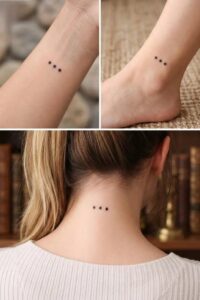
At first glance, the three-dot tattoo may appear simple—almost too minimal to carry any real significance. Three small marks, often arranged in a triangle or a line, don’t immediately suggest depth or complexity. Yet this understated design has become one of the most symbolically rich forms of body art across cultures and communities.
Beneath its subtle appearance lies a layered narrative shaped by history, philosophy, personal identity, and social context. What seems like a small cluster of ink can represent entire life journeys, deeply held beliefs, or connections to others that words often fail to capture.
From its placement on the hand or knuckles to its hidden presence on the wrist or ankle, the three-dot tattoo tells a story that is rarely obvious at first glance. Its meaning depends not only on the design itself but also on the individual wearing it, their experiences, and the cultural environment surrounding them.
This is what gives the tattoo its enduring appeal. It is not fixed or rigid in meaning. Instead, it evolves—just like the people who choose to wear it.
Origins and Symbolic Interpretations
One of the most widely recognized meanings of the three-dot tattoo is its connection to the Three Wise Monkeys.
This ancient proverb emphasizes restraint, awareness, and moral discipline. In this interpretation, each dot represents a guiding principle:
- See no evil
- Hear no evil
- Speak no evil
Rather than encouraging ignorance, the message promotes mindfulness—choosing not to engage in negativity, gossip, or harmful actions. For many wearers, the tattoo becomes a quiet reminder to live with intention and integrity.
Beyond this philosophical meaning, the design also symbolizes unity and loyalty in certain communities. In close-knit groups, the three dots can represent shared values, mutual trust, and a sense of belonging. It acts as a subtle marker of connection—something recognizable to those who understand its meaning, yet unobtrusive to outsiders.
This dual nature—both personal and communal—is part of what makes the tattoo so powerful. It can be deeply private while still carrying social significance.
A Personal Narrative in Three Points
For many individuals, the three-dot tattoo holds a meaning that goes far beyond cultural symbolism. It becomes a personal story told through minimal form.
Each dot may represent a phase of life:
- The past, filled with lessons and experiences
- The present, grounded in awareness
- The future, shaped by hope and intention
Others interpret the dots as markers of transformation—struggle, growth, and resilience. In this context, the tattoo becomes a quiet acknowledgment of challenges overcome and strength gained.
Some choose to link each dot to relationships or memories—family, friendship, and self. In doing so, the design becomes a constant reminder of what matters most.
Unlike more elaborate tattoos that tell a literal story, the three-dot tattoo relies on suggestion. Its simplicity invites reflection, allowing the meaning to remain fluid and deeply personal.
Over time, that meaning can evolve. What begins as a symbol of survival may later represent wisdom. What once marked a difficult chapter may come to signify strength and renewal.
Cultural Context and Regional Variations
The meaning of the three-dot tattoo is not universal. Across different regions and communities, its interpretation shifts while retaining a core connection to identity and expression.
In some cultures, it represents a life journey—often described as “my life, my path.” This interpretation emphasizes independence and personal growth, highlighting the idea that life is shaped by individual choices and experiences.
In other contexts, the tattoo has been associated with subcultures where it symbolizes resilience and survival. These meanings are often rooted in shared experiences, reflecting challenges faced and overcome within specific communities.
Even subtle differences in design can influence interpretation. A triangular arrangement may carry a different connotation than a straight line, and spacing between the dots can affect how the tattoo is perceived.
Placement also plays a role. A visible tattoo on the hand may suggest openness and confidence, while a hidden placement may indicate a more private meaning known only to the wearer.
These variations highlight an important truth: the tattoo’s meaning is never fixed. It is shaped by context, intention, and perspective.
Misinterpretations and Social Perception
Despite its rich symbolism, the three-dot tattoo is sometimes misunderstood. In certain environments, it has been linked to subcultures or even criminal associations, leading to assumptions about the wearer that may not reflect reality.
This disconnect between perception and intention can create challenges. A design chosen for personal or philosophical reasons may be interpreted through an entirely different lens by others.
Such misunderstandings reveal how visual symbols can carry multiple meanings simultaneously—some accurate, others imposed.
For many wearers, this becomes an opportunity rather than a limitation. It reinforces the idea that meaning is not defined by external judgment but by personal intention.
It also serves as a reminder for observers to approach visible symbols with curiosity rather than assumption. Tattoos, like people, often carry stories that are far more nuanced than they appear.
The Power of Minimalism in Tattoo Art
The three-dot tattoo is a perfect example of how minimalism can carry profound meaning.
In a world where tattoos are often intricate and detailed, this design stands out for its simplicity. It proves that meaning does not require complexity. In fact, simplicity can make a symbol more powerful by leaving space for interpretation.
Minimalist tattoos encourage reflection. They invite questions rather than providing answers. This openness allows each wearer to define their own narrative without limitation.
The three-dot design also reflects a broader cultural shift toward subtle forms of self-expression. Instead of bold declarations, many people are drawn to symbols that are quiet, personal, and enduring.
This approach aligns with the idea that identity is not always meant to be displayed loudly. Sometimes, it is expressed through small, intentional choices that carry deep significance.
Historical and Cultural Roots
While modern interpretations vary, the use of dot patterns in body art dates back centuries. Many indigenous and tribal cultures used simple markings to convey identity, status, or spiritual beliefs.
In some traditions, three marks represented balance—connecting mind, body, and spirit. In others, they symbolized a relationship with nature or ancestors.
These early uses demonstrate that minimal designs have long carried deep meaning. The three-dot tattoo continues this tradition, adapting ancient symbolism to modern contexts.
In more recent history, the design gained popularity in urban environments, where it became a subtle form of communication. Its simplicity made it easy to replicate, while its meaning remained flexible.
This adaptability is key to its longevity. The tattoo has evolved across time and culture without losing its core essence.
Placement and Its Deeper Meaning
Where the tattoo is placed can be just as meaningful as the design itself.
A common location is between the thumb and forefinger—a spot that is visible yet easy to conceal. This placement often reflects a balance between openness and privacy.
Knuckle tattoos tend to be more visible and may suggest confidence or a willingness to share the symbol with others. Wrist or ankle placements, on the other hand, are often more personal, intended for the wearer rather than the public.
Placement can also influence how the tattoo is perceived. A visible tattoo may invite conversation or curiosity, while a hidden one may serve as a private reminder.
In this way, the tattoo becomes not just a symbol, but a choice about how and when to share its meaning.
Stories of Resilience and Identity
For many people, the three-dot tattoo represents resilience.
It can mark survival through difficult experiences, serving as a reminder of strength and perseverance. Each dot becomes a symbol of a moment, a lesson, or a turning point.
These personal stories are often invisible to others, yet deeply significant to the wearer. The tattoo becomes a quiet acknowledgment of what has been endured and overcome.
It also plays a role in identity formation. By choosing a symbol with flexible meaning, individuals create space for their identity to grow and evolve.
Unlike fixed symbols, the three-dot tattoo adapts over time, reflecting changes in perspective and experience.
The Psychology Behind Minimalist Tattoos
From a psychological perspective, minimalist tattoos like the three-dot design can have a powerful impact.
Because their meaning is often internal, they act as personal anchors—reminders of values, goals, or experiences. Seeing the tattoo can trigger reflection, helping individuals stay connected to what matters most.
This internal focus makes the tattoo less about appearance and more about intention. It becomes a tool for mindfulness, encouraging awareness in everyday life.
The flexibility of interpretation also allows the tattoo to remain relevant over time. As life changes, the meaning can shift without altering the design.
This adaptability is one of the reasons minimalist tattoos continue to grow in popularity.
Navigating Meaning and Misunderstanding
While the three-dot tattoo carries deep significance, it also highlights the importance of context.
Symbols are rarely universal. Their meaning depends on culture, environment, and individual perspective.
For wearers, this means balancing personal expression with awareness of how the tattoo may be perceived. For observers, it means recognizing that visible symbols often have hidden stories.
This dynamic creates an opportunity for greater understanding. By looking beyond assumptions, we can appreciate the complexity behind even the simplest designs.
Why the Three-Dot Tattoo Endures
The enduring popularity of the three-dot tattoo lies in its versatility.
It can represent philosophy, identity, relationships, or personal growth—all within a design that takes only seconds to draw.
Its simplicity makes it accessible, while its depth gives it lasting meaning.
In a world filled with noise and complexity, the tattoo offers something different: quiet significance.
It does not demand attention, yet it holds it. It does not explain itself, yet it invites interpretation.
Conclusion: Small Symbol, Profound Meaning
The three-dot tattoo is far more than a minimalist design. It is a symbol shaped by culture, experience, and personal intention.
Whether connected to the Three Wise Monkeys, a life journey, or a story of resilience, it demonstrates how even the smallest marks can carry powerful meaning.
Its true value lies not in how it looks, but in what it represents.
In a society where appearances often dominate, the three-dot tattoo reminds us to look deeper—to recognize that meaning is not always visible at the surface.
Sometimes, the simplest symbols hold the most profound stories.