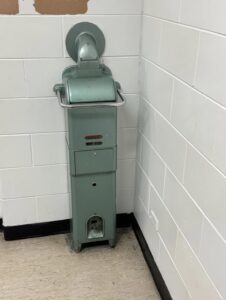
Sometimes, the most ordinary places hide the most unexpected reminders of the past.
It happened to me in a place most people wouldn’t think twice about—a school restroom.
I wasn’t looking for history. I wasn’t searching for anything unusual. But there it was, mounted quietly on the wall, almost blending into the background.
An old metal incinerator.
At first glance, it looked like nothing more than an outdated fixture. Heavy, dull, and slightly intimidating in its design. The kind of object that feels out of place in today’s world but still lingers as a silent witness to another time.
I paused.
There was something about it that made me curious.
Why was it there? What was it used for? And more importantly—what did it say about the people who once relied on it?
That single moment of curiosity led me down a path of discovery, one that revealed much more than I expected.
Because that old incinerator wasn’t just a forgotten object.
It was a window into how people once lived, thought, and solved everyday problems.
A Different Way of Thinking About Waste
Today, we’re used to a certain system when it comes to dealing with trash.
We separate recyclables. We use designated bins. Garbage trucks arrive on schedule. Waste disappears from our homes and is handled somewhere out of sight.
But it wasn’t always like this.
There was a time when managing waste was a personal responsibility—something every household had to figure out on its own.
And for many people, the simplest solution was fire.
When Burning Trash Was Normal
For decades, burning trash was one of the most common ways to get rid of it.
It was simple.
You gathered your waste, lit it on fire, and watched it disappear.
What was once a pile of garbage turned into a small amount of ash within minutes.
It felt efficient.
It felt clean.
And most importantly, it felt final.
There was no need to transport trash somewhere else or worry about where it ended up.
It was gone.
Or at least, it seemed that way.
The Everyday Reality of Smoke and Ash
In many neighborhoods, the sight—and smell—of burning trash was part of daily life.
People burned waste in their backyards using metal barrels or small pits dug into the ground.
The smoke drifted through the air.
The scent lingered.
Ash settled on nearby surfaces.
And no one thought much of it.
It was simply how things were done.
Children grew up seeing it.
Families accepted it.
Communities adapted to it.
It wasn’t considered strange or harmful.
It was normal.
Incinerators Inside Homes and Buildings
As time went on, this idea of burning waste became more structured.
Instead of using open fires, people began installing incinerators in homes and buildings.
These weren’t just outdoor tools anymore.
They became part of everyday infrastructure.
Apartment buildings had shared incinerators for residents.
Hospitals used them to handle waste quickly and discreetly.
Schools installed them in restrooms and utility areas.
They were designed to make disposal easier, faster, and more contained.
But at their core, the idea remained the same:
Burn it, and it’s gone.
The Bathroom Incinerator
That’s what made the incinerator I saw in the restroom so interesting.
It wasn’t just a random piece of equipment.
It served a very specific purpose.
In many public buildings, especially schools, these incinerators were used to dispose of sanitary waste.
At the time, hygiene was viewed through a very different lens.
The goal wasn’t just to manage waste—it was to eliminate it completely.
Fire offered a sense of finality.
Once something was burned, it no longer existed in a visible or tangible way.
For many people, that felt cleaner than simply throwing something into a bin.
There was also an element of privacy.
Certain types of waste were considered personal or sensitive.
Burning them ensured they were handled discreetly, without being seen or handled by others.
Today, that approach might seem extreme.
But at the time, it was seen as practical.
Even responsible.
How Every Household Managed Waste Differently
One of the most fascinating things about this period in history is how personal waste management was.
There wasn’t a single system everyone followed.
Each household developed its own methods.
Some families burned their trash regularly.
Others buried it in their yards.
Some transported it to local dumping areas.
And many people reused as much as possible.
Glass jars were saved and repurposed.
Metal tins were reused until they wore out.
Old fabric became cleaning rags.
Food scraps were often given to animals.
Very little went to waste if it could be used again.
This approach wasn’t just about necessity.
It was also about mindset.
People were more directly connected to what they consumed—and what they threw away.
The Shift Toward Convenience
Everything began to change in the mid-20th century.
As industries grew and manufacturing evolved, new types of products entered everyday life.
Disposable items became more common.
Plastic packaging began to replace traditional materials.
Convenience became a selling point.
Products were designed to be used once and then thrown away.
It was presented as progress.
And in many ways, it was.
Life became easier.
Faster.
More efficient.
But there was a trade-off.
More Waste, Same Habits
Even as the type of waste changed, the methods of disposal didn’t.
People continued to burn, bury, and discard trash in the same ways they always had.
But now, the materials were different.
Instead of paper and organic waste, there were plastics, chemicals, and synthetic materials.
These didn’t behave the same way when burned.
They produced different kinds of smoke.
Different residues.
Different effects.
But at the time, most people didn’t fully understand the consequences.
The Blind Spots of the Past
It’s easy to look back now and question these practices.
But it’s important to understand the context.
People weren’t careless.
They simply didn’t have the same information we do today.
There was awareness of visible issues—dirt, odor, and bacteria.
But the invisible risks were less understood.
Air pollution.
Toxic fumes.
Long-term environmental damage.
These concepts weren’t as widely recognized or discussed.
If trash disappeared, the problem was considered solved.
Out of sight meant out of mind.
Why It All Made Sense Back Then
From a modern perspective, burning mixed waste or disposing of materials without much thought might seem risky.
But at the time, it was logical.
It was efficient.
And it aligned with the knowledge people had available.
There were fewer regulations.
Less scientific research available to the public.
And fewer large-scale systems for waste management.
So people did what worked.
What felt right.
What solved the problem in front of them.
The Hidden Costs
Over time, the effects of these practices became clearer.
Communities began to notice changes in air quality.
Health concerns started to emerge.
Environmental awareness grew.
And slowly, new systems replaced old habits.
Landfills became more regulated.
Recycling programs were introduced.
Public awareness campaigns encouraged safer practices.
The shift didn’t happen overnight.
But it happened.
What That Old Incinerator Really Represents
Standing there in that restroom, looking at that old metal incinerator, I realized something.
It wasn’t just a piece of equipment.
It was a symbol.
A reminder of how people approached everyday challenges.
It reflected a time when solutions were direct and immediate.
When problems were handled with the tools and knowledge available.
It told a story about priorities.
About values.
About the balance between convenience and understanding.
Why These Relics Still Matter
Objects like that incinerator might seem outdated or unnecessary today.
But they serve an important purpose.
They remind us of where we came from.
They show us how much has changed.
And they help us appreciate the systems we have now.
They also encourage reflection.
What are we doing today that future generations might question?
What habits seem normal now, but could later be seen differently?
Looking at the Past with Perspective
It’s easy to judge the past using modern knowledge.
But history is best understood with context.
People made decisions based on what they knew at the time.
They adapted to their environment.
They solved problems in ways that made sense to them.
And in many cases, they laid the groundwork for the improvements we benefit from today.
A Simple Object, A Bigger Story
That old incinerator may no longer be in use.
It may never be used again.
But it still has something to say.
It tells a story about innovation.
About practicality.
About the evolution of everyday life.
And sometimes, the most ordinary objects carry the most meaningful lessons.
Final Thoughts
The next time you come across something old or unfamiliar, take a moment to look closer.
Ask questions.
Be curious.
Because you might discover that what seems outdated or insignificant is actually part of a much larger story.
A story about how people lived.
How they adapted.
And how the world slowly changed over time.
Sometimes, history isn’t found in museums or books.
Sometimes, it’s quietly sitting on a wall—waiting to be noticed.