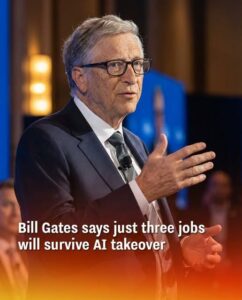
As artificial intelligence rapidly reshapes industries around the world, one big question keeps coming up: which jobs will actually survive? According to tech leader Bill Gates, the future of work may look very different—but not all roles are at risk. In fact, he believes a small number of professions will remain essential, even as AI becomes more advanced. His perspective has sparked widespread discussion, especially as more companies begin integrating AI into everyday operations.
AI is already changing how businesses function, from automating routine tasks to assisting with decision-making. Some reports suggest that certain roles are becoming less in demand as companies adopt smarter systems. However, experts emphasize that AI is more of a tool than a full replacement in many cases. While it can process data quickly and perform repetitive tasks, it still relies heavily on human oversight, creativity, and judgment—qualities that are harder to replicate.
Gates highlights three key areas where human expertise is expected to remain crucial. First, software developers will continue to play a major role, as AI systems still require human guidance, maintenance, and improvement. Second, professionals in scientific research—especially in fields like biology—bring creativity and critical thinking that drive new discoveries. Finally, workers in the energy sector are expected to remain indispensable due to the complexity and responsibility involved in managing resources and infrastructure.
Although some jobs may evolve or decline over time, the overall picture is more balanced than it may seem. Many roles will adapt alongside AI rather than disappear entirely. As technology continues to develop, the most valuable skills will likely be those that combine human insight with technological tools. In the end, the future of work may not be about competition between humans and AI—but about how effectively they can work together.