Introduction
When someone who has shaped your entire life passes away, the world can suddenly feel unfamiliar and quiet. For me, that moment came when my uncle—who had raised me for most of my life—was laid to rest. I was twenty-six years old, and after the funeral ended and the last visitors had gone home, the house felt emptier than it ever had before.
My uncle had been my constant for as long as I could remember. After losing my parents as a child, he stepped forward and took on the role of guardian, teacher, and protector. Everything I knew about family came from him.
But shortly after his funeral, something unexpected happened.
A neighbor placed an envelope in my hands—something my uncle had asked her to give me after he was gone. Inside was a letter that revealed a truth he had kept hidden for decades. Reading it forced me to reconsider everything I thought I knew about my past, my parents, and the man who raised me.
What I discovered wasn’t simple. It wasn’t easy to accept. Yet, it also revealed something deeply human about mistakes, responsibility, and the complicated ways people try to make things right.
This is the story of the uncle who raised me, the secret he carried for years, and how learning the truth changed the way I understood my life.
A House That Suddenly Felt Too Quiet
The day of the funeral had been long and emotionally exhausting. Friends, neighbors, and distant relatives came to pay their respects and share stories about the man they knew.
Many of them said the same thing.
“He was a good man.”
I heard the words over and over throughout the afternoon. Each person seemed to have a story about how he helped someone fix a car, repaired a fence, or quietly stepped in when someone needed help.
Those stories were comforting, but when the final guests left and the house grew silent again, the weight of loss felt overwhelming.
That’s when Mrs. Patel, our longtime neighbor, approached me with a small envelope.
Her eyes were red from crying, and her voice trembled slightly.
“Your uncle asked me to give this to you,” she said gently. “And he told me to say… he’s sorry.”
I looked down at the envelope, confused.
Sorry for what?
At that moment, I had no idea that the letter inside would reveal a truth that had been hidden since I was a child.
The Life I Remember Before Everything Changed
Most people assume that my story begins with the accident that changed my life. But I remember pieces of life before that moment.
My earliest memories are small and colorful fragments—moments that still feel warm and vivid.
I remember my mother singing loudly in the kitchen, often off-key but always with enthusiasm. Music seemed to follow her everywhere.
My father worked long hours and often came home smelling faintly of motor oil and peppermint gum. I remember how he would scoop me up and spin me around, laughing when I squealed with excitement.
There were simple childhood things too—light-up sneakers that blinked when I walked, a favorite purple cup I carried everywhere, and a strong opinion about which cartoons were the best.
Those early memories feel like scenes from another life.
Then, when I was four years old, everything changed.
The Accident That Altered Everything
The story I grew up hearing about the accident was straightforward.
My parents had been driving late at night when their car crashed. They didn’t survive the impact. I did, but my spine was severely injured.
The result was permanent paralysis from the waist down.
That explanation was repeated so many times that it eventually became the accepted version of events in my mind. It was tragic, but it seemed like a random misfortune—one of those heartbreaking accidents that happen without warning.
After the crash, I spent weeks in the hospital recovering from surgeries and adjusting to the reality that I would no longer walk.
During that time, social workers began discussing my future.
Because my parents had passed away, the next step was deciding where I would live.
The Day My Uncle Stepped In
I remember the hospital room clearly. A social worker stood near the bed holding a clipboard. She spoke in a gentle voice, explaining that they would find a loving foster family for me.
She assured me everything would be okay.
Before she finished speaking, someone interrupted.
My uncle Ray had arrived.
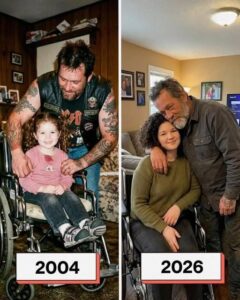
Ray was my father’s brother. He was tall, broad-shouldered, and rarely smiled. His hands were rough from years of manual work, and he carried himself with a quiet seriousness that sometimes made people nervous.
He listened to the social worker’s explanation and then shook his head.
“No,” he said firmly. “She’s coming with me.”
At the time, I didn’t realize how big a decision that was.
Ray didn’t have children. He lived alone in a modest house. And he had never taken care of a child with complex medical needs.
But he didn’t hesitate.
From that moment forward, he became my guardian.
Learning to Care for a Child With Special Needs
When Ray brought me home, everything about his life changed overnight.
The house smelled like coffee and motor oil, and it wasn’t designed for someone using a wheelchair. But Ray was determined to make it work.
He started learning everything he could.
He watched nurses carefully during hospital visits, writing down notes in a small notebook he kept in his pocket. He asked endless questions about medical equipment, physical therapy, and daily care routines.
The first few weeks were difficult.
There were moments when both of us felt overwhelmed. But Ray never gave up.
The Late-Night Routine
One of my earliest memories from that time is the sound of Ray’s alarm clock going off during the night.
Every two hours, the alarm would ring.
Ray would shuffle into my room, half-asleep, with messy hair and tired eyes. His job was to gently reposition me so I wouldn’t develop pressure sores.
He always tried to lighten the moment with humor.
“Pancake time,” he’d mutter as he carefully rolled me onto my other side.
If I woke up scared or uncomfortable, he would whisper reassuringly, “I’ve got you, kiddo.”
Those nights were exhausting for him, but he never complained.
Making the House Accessible
As time passed, Ray began transforming the house to make it easier for me to move around.
He built wooden ramps at the front and back doors. He lowered shelves so I could reach them from my wheelchair.
One afternoon, he spent hours welding together a custom stand that allowed me to use a tablet comfortably.
He even built a raised planter box in the backyard after I once complained that I couldn’t reach the herbs growing in the garden.
“You shouldn’t miss out on things just because they’re built for standing people,” he said.
Learning the Everyday Things
There were many things Ray had never done before becoming my guardian.
He had to learn how to braid hair.
His first attempts were… not great.
My braids often came out crooked or uneven, but he practiced until he got better.
When I got older, he watched online videos to learn how to shop for things like makeup and hygiene products.
He once spent nearly an hour in a store trying to figure out which items I needed.
When I teased him about it later, he shrugged.
“You deserved someone who tried,” he said.
The Lessons He Repeated
Growing up in a wheelchair sometimes made me feel different from other kids.
There were school dances I couldn’t easily attend and crowded places that made navigating difficult.
Whenever I became discouraged, Ray repeated the same message.
“You’re not less,” he would say firmly. “You hear me? You’re not less.”
Those words became one of the most important lessons he gave me.
Signs That Something Was Wrong
Years passed, and Ray continued taking care of me. But eventually, I started noticing changes.
He seemed more tired than usual.
Simple tasks that once seemed easy for him began taking longer.
Sometimes he had to stop halfway up the stairs to catch his breath.
At first, he dismissed my concerns.
But eventually, he went to see a doctor.
The Diagnosis
When the diagnosis came, it changed everything again.
The doctor explained that Ray had stage four cancer.
It had already spread throughout his body.
Treatment options were limited.
Ray tried to remain calm when he told me, but I could see the worry in his eyes.
Soon, hospice care began visiting the house regularly.
Machines appeared in the living room. Medication schedules were taped to the refrigerator.
The house that had once been full of activity became quieter.
Our Last Conversation
The night before Ray passed away, he came into my room and sat beside my bed.
He looked tired but peaceful.
“You know you’re the best thing that ever happened to me, right?” he said.
I tried to lighten the mood.
“That’s kind of sad,” I joked.
He smiled slightly.
“Still true,” he said.
I told him I didn’t know what I would do without him.
He reached out and squeezed my hand.
“You’re going to live,” he said firmly. “You hear me? You’re going to live.”
Then he added something unexpected.
“I’m sorry… for things I should’ve told you.”
At the time, I didn’t understand what he meant.
The next morning, he was gone.
The Letter That Changed Everything
Now, standing in the quiet house after his funeral, I opened the envelope he had left for me.
The handwriting on the paper was unmistakably his.
The first sentence made my heart race.
“Hannah,” the letter began. “I’ve been lying to you your whole life.”
As I read further, my understanding of the past began to shift.
Ray explained that the night of the accident had been more complicated than I knew.
According to his letter, my parents had come to his house earlier that evening.
They had planned to move away—and they had decided not to take me with them.
They believed I would have a more stable life living with Ray.
The conversation quickly turned into an argument.
Ray admitted that his temper got the better of him.
Harsh words were exchanged.
Eventually, my parents left the house angry.
Ray wrote that he had been drinking that night and allowed the argument to continue instead of calming things down.
Twenty minutes later, the police called.
My parents’ car had crashed into a utility pole.
They didn’t survive.
The Weight of Guilt
Ray confessed that for a long time he blamed himself.
He believed that if he had handled the argument differently, the crash might never have happened.
When he first took me home from the hospital, he admitted that he saw me as a painful reminder of that night.
But over time, something changed.
He realized I had done nothing wrong.
I was simply a child who survived.
Caring for me became his way of trying to make things right.
What He Wanted for My Future
Near the end of the letter, Ray explained that he had prepared for my future.
He had set aside money in a trust.
He had sold the house and arranged for a lawyer to help manage the details.
He wanted to make sure I had the resources to live independently.
“Your life doesn’t have to stay the size of that room,” he wrote.
The final lines of the letter were simple but emotional.
“If you can forgive me, do it for yourself,” he wrote. “So you don’t spend your life carrying my mistakes.”
Moving Forward
In the weeks after reading the letter, I struggled with many emotions.
There was sadness, confusion, and anger.
But there was also gratitude.
Ray had made mistakes in the past, but he had spent decades trying to take responsibility for them.
Eventually, I decided to focus on moving forward.
I enrolled in a rehabilitation program designed to strengthen my muscles and improve mobility.
The therapy sessions were challenging.
But each small improvement felt meaningful.
A Moment I Never Expected
Recently, something happened that I once thought was impossible.
During a therapy session, I stood upright with support from a harness and treadmill system.
For the first time since I was four years old, most of my weight rested on my own legs.
I was shaking and emotional—but I was standing.
In that moment, I heard Ray’s voice in my mind.
“You’re going to live, kiddo.”
A Complicated Kind of Forgiveness
People sometimes ask whether I forgive him.
The answer isn’t simple.
Some days, I feel the weight of the truth he revealed.
Other days, I remember the years he spent caring for me—every late-night alarm, every homemade ramp, every reminder that I wasn’t less.
Forgiveness doesn’t always happen all at once.
Sometimes it happens slowly, piece by piece.
Ray carried me as far as he could.
Now the rest of the journey belongs to me.