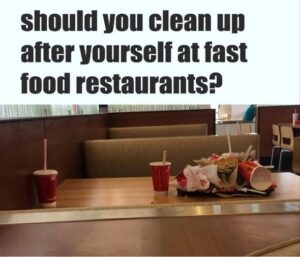
Introduction: The Divide Over Fast Food Etiquette
Fast food restaurants are often seen as casual, no-frills establishments designed for quick service and affordable meals. Yet, beneath this simple exterior lies an ongoing debate: should customers clean up after themselves or leave it to the restaurant staff? This seemingly small question raises broader issues about shared responsibility in public spaces, courtesy, and the expectations surrounding service. For some, cleaning up after a meal feels like a basic act of decency, while others argue that the responsibility lies with the restaurant, as part of the service package. The divide over this seemingly trivial issue highlights how people view their role in communal spaces, and how they approach the concept of “public” versus “private” responsibility.
While the debate may seem insignificant at first glance, it sheds light on deeper social norms and practices, especially in spaces where we spend a lot of time but don’t necessarily feel a personal ownership. Fast food restaurants, as common gathering points in our daily lives, serve as a microcosm of larger societal discussions about respect, responsibility, and public manners. Should the customer who enjoys a quick meal and leaves a mess feel any obligation to clean up? Or is it the responsibility of the service staff who, after all, are paid to provide a service?
This article will explore the key arguments surrounding this debate, examine the broader context of public space responsibility, and offer insights into how each side of the argument contributes to our shared experiences in public spaces like fast food restaurants.
The Hidden Etiquette: Why Some Believe You Should Clean Up
Personal Responsibility and Respect for Others
For many people, cleaning up after themselves at a fast food restaurant is not just about convenience—it’s an expression of basic respect for others who will use the space after them. This view is rooted in the broader concept of personal responsibility, which extends beyond the individual and takes into account how one’s actions affect others. When you eat a meal and leave trash behind, the next person who sits down at that table is faced with your mess. A sticky table, crumbs, or discarded napkins are all part of the “public space” experience. As one person puts it, “I was here, and I left it decent for you.” In this sense, the act of cleaning up after yourself goes beyond self-interest and acknowledges a shared responsibility to maintain a clean environment for others.
Moreover, fast food establishments often see high turnover in customer traffic. With limited staff handling large volumes of patrons, restaurant employees are frequently focused on maintaining the kitchen, preparing food, and keeping the dining area functioning smoothly. Many workers are already stretched thin, performing a variety of tasks such as cleaning, order fulfillment, and even customer service. By taking the extra few moments to gather your own trash and place it in the appropriate disposal bin, you contribute to a more efficient system that can free up staff time for other critical tasks.
Creating a Pleasant Environment for Everyone
Another key reason why some customers believe they should clean up is the simple desire to make the environment more pleasant for everyone. Fast food restaurants are often bustling with activity, and a little self-awareness can go a long way in improving the dining experience. Keeping the space clean and orderly contributes to a more pleasant environment for future guests, especially in establishments with limited staff available for cleaning.
Imagine arriving at a restaurant only to find the tables littered with napkins, wrappers, and spilled condiments. Such a scene is not only off-putting but can also impact a person’s perception of the restaurant’s level of cleanliness and professionalism. By taking responsibility for your own space, you help ensure that others are greeted with a clean and inviting environment, one that encourages positive experiences and a sense of respect for shared public spaces.
Additionally, in the age of heightened health concerns, particularly in the wake of the COVID-19 pandemic, cleanliness in public spaces is more important than ever. People have become more conscious of the germs and bacteria they might encounter in shared spaces. By cleaning up after yourself, you reduce the likelihood of leaving behind something that could contribute to the spread of illness.
How It Contributes to a Better Customer Experience
For the most part, fast food restaurants are designed to provide a quick, efficient experience for the customer. This means customers don’t linger for extended periods or engage in long, drawn-out dining experiences. Yet, this doesn’t absolve them of the responsibility of cleaning up after their meal. On the contrary, being aware of how your behavior affects the next customer fosters a better overall atmosphere for everyone. A dining space that is tidy and organized is more inviting and allows for quicker turnovers, keeping the restaurant running smoothly and improving service speed.
Moreover, when customers clean up after themselves, they set a good example for others, especially children or less conscientious individuals who might otherwise assume it’s okay to leave behind their messes. This is part of a broader societal conversation about instilling a sense of respect and responsibility from a young age, teaching kids not only how to take care of their own spaces but also how to respect the shared spaces of others.
The Contrarian View: Why Some Believe It’s Not Your Job
The Role of Restaurant Staff and Service Expectations
On the other hand, there are those who argue that cleaning up after yourself in a fast food restaurant should not be expected of customers. After all, these businesses are designed to provide a full service, and that includes cleaning up after patrons. In many people’s minds, the transaction between a customer and a fast food restaurant is clear: the customer pays for food, and the restaurant provides a clean space, food, and service. This service model inherently includes cleanup as part of the equation, which means it’s the responsibility of the restaurant staff to maintain the dining area, not the customers.
For employees working at a fast food restaurant, this often means regular cleaning of tables, sweeping the floor, and ensuring that the trash bins are emptied and ready to receive new waste. Many fast food establishments already include these tasks in their service model and training. In a sense, the customer’s payment covers not only the food but also the cleaning and maintenance of the space.
Moreover, fast food restaurants, particularly those with self-service areas, are designed with trash bins, condiment stations, and cleaning supplies readily available for customer use. This setup suggests that the business expects patrons to dispose of their own waste—similar to the process of using a public restroom or park. Yet, unlike restaurants with table service, where the waitstaff often clears the table as part of the service, fast food restaurants rely on customers to take an active role in cleaning up after themselves, with little or no direct interaction with staff during the dining process.
For some, the notion that customers should be responsible for tidying up after their meal is unnecessary, as the cost of dining should cover everything, including cleanup. Employees are hired specifically to handle these tasks, so why should customers be expected to do it themselves?
The Speed and Nature of Fast Food Dining
Another argument against cleaning up is the nature of fast food dining itself. Fast food is often associated with quick service and even quicker meals. Customers are typically in and out in a matter of minutes, leaving little time to engage in activities like cleaning up after oneself. In these environments, customers often feel a sense of urgency to finish their meal and move on, leading to a reluctance to spend any additional time cleaning up.
Unlike sit-down restaurants, where customers linger and take part in a more leisurely dining experience, fast food restaurants operate at a much faster pace. This means the emphasis is placed more on efficiency and less on tidying up after oneself. Customers might feel justified in quickly leaving once their meal is finished, as their focus is on the speed of the experience, rather than the cleanliness of the table or surrounding area.
Additionally, many fast food establishments are designed with a more transactional focus, where the customer’s role is to purchase and consume food, rather than engage in extended social interaction or additional tasks such as cleanup. For some, this transactional relationship extends only to paying for food and eating it, leaving all other duties, like cleaning up, to the staff who are compensated to handle these tasks.
The Case for Professionalism and Service Standards
It is also important to consider the professional standards that businesses are expected to uphold. The argument here is that just as we expect clean and tidy tables when we arrive at a fast food restaurant, we should also expect that cleaning the space afterward is part of the service. If businesses want to attract customers, they need to maintain a high standard of cleanliness. This responsibility lies with the restaurant owners and management, not with the customers.
In fact, some people argue that putting the burden of cleaning up on customers may be a bad business practice that reflects poor operational standards. If the restaurant has created an environment where customers are expected to do part of the cleaning, it could indicate a lack of adequate staffing or a failure to meet basic customer service expectations.
The Middle Ground: Striking a Balance Between Responsibility and Expectations
While the debate between customers cleaning up and leaving it to the restaurant staff can seem divisive, there may be a middle ground where both sides can agree. Here are some actionable solutions and suggestions for both restaurant-goers and businesses:
For Customers:
-
Tidy up your space: If you have time and it’s convenient, gather your trash and place it in the nearest trash bin. This small act of courtesy helps maintain a pleasant dining environment for others.
-
Be mindful of staff workload: Understand that restaurant staff are often juggling multiple tasks. If you can lend a hand by leaving the table in good condition, it can make their job easier and faster.
-
Consider your habits: If you are frequently in a hurry, consider whether your eating habits at fast food restaurants can be adjusted to allow for quick clean-up, such as using trays and napkins to contain waste.
For Restaurant Owners and Managers:
-
Maintain a clear service model: If your restaurant’s service includes cleanup, make sure it’s clearly communicated to customers and consistently delivered.
-
Provide ample waste disposal options: Place easy-to-access trash bins and cleaning supplies in visible locations so customers feel empowered to clean up after themselves.
-
Train staff accordingly: Ensure that employees are well-trained in handling all aspects of the restaurant, including cleanliness, customer interaction, and quick service. An organized team can make cleanup much easier for everyone involved.
Conclusion: A Shared Responsibility for a Better Experience
In the end, whether or not you clean up after yourself at a fast food restaurant is a matter of personal choice. It boils down to an understanding of shared responsibility and respect for public spaces. While some believe it’s the restaurant’s job to maintain the space, others view cleaning up as part of basic decency. Regardless of where you stand, it’s clear that everyone plays a part in ensuring that fast food dining remains a positive, efficient experience for all.
By finding a balance between personal responsibility and service expectations, we can make these public spaces more pleasant for everyone—from the person eating their meal to the staff maintaining the restaurant. It’s a small, thoughtful act that can make a big difference in the way we experience communal spaces, creating an environment of respect and consideration that benefits all.