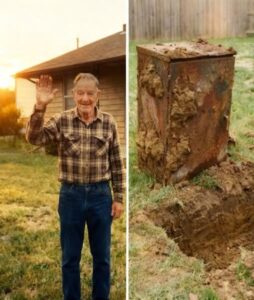
I always believed my life rested on solid ground.
At thirty-eight, I was the kind of woman people described as steady. Reliable. Organized. The one who remembered birthdays, who coordinated carpools, who kept extra batteries in a labeled kitchen drawer “just in case.” I was a mother of two energetic children, a wife of twelve years, and—somehow—the unofficial caretaker of our quiet suburban block.
If someone’s newspaper piled up, I noticed. If a porch light flickered out, I texted the homeowner. If a new family moved in, I brought over banana bread and a handwritten welcome note.
I thought I understood where I came from. I thought I understood my story.
I was wrong.
The Life I Thought I Knew
My mother, Nancy, raised me with clear principles: keep your word, work hard, and avoid unnecessary drama. She believed secrets complicated things. She believed the truth—however blunt—was always better than uncertainty.
Except, as I would later learn, that wasn’t entirely true.
Growing up, I knew very little about my father. What I did know came from my mother, delivered in carefully measured sentences.
“He wasn’t ready for responsibility.”
“He left before you were old enough to remember.”
“It’s better this way.”
There were no photographs. No stories. No dramatic arguments overheard through bedroom walls. Just absence.
And I accepted it.
Children have a way of filling in gaps with assumptions that feel logical. I imagined a man who drifted from town to town, who preferred freedom over family, who made choices without looking back.
My mother never spoke bitterly. She spoke firmly. As if the matter were closed.
So I closed it too.
The Neighbor Next Door
For eight years, Mr. Whitmore lived in the modest gray house beside ours.
He was elderly when we moved in—already in his late seventies. He kept his lawn trimmed precisely, wore pressed button-down shirts even on hot afternoons, and walked with a cane carved with a small bird at the top.
He was kind in quiet ways.
When my son Ben was five and obsessed with bugs, Mr. Whitmore gifted him a magnifying glass. When my daughter Lily performed in her first school play, he attended without telling us beforehand and slipped a single yellow rose into her hand afterward.
He baked apple pies every autumn. The scent drifted over the fence and into our yard.
Looking back now, I realize how often he watched.
Not in a strange way. In a careful way. A protective way.
At the time, I simply thought he was a lonely widower who enjoyed the liveliness of children next door.
He never mentioned having family.
The Funeral
When Mr. Whitmore passed away, it was sudden.
A heart condition, the paramedics said.
The funeral was small. A few distant relatives. Some former coworkers. Neighbors from the block.
I stood near the back with my husband, Mark, holding Lily’s hand.
It felt strange to say goodbye to someone who had been so consistently present in the background of our lives.
Afterward, I helped coordinate a meal train for the relatives staying in town. Old habits—order in times of grief.
I thought that would be the end of it.
I was wrong.
The Envelope
The morning after the funeral, I opened our mailbox expecting the usual bills and grocery flyers.
Instead, there was a single envelope addressed in careful blue ink.
To: Emily Carter.
My name.
No return address.
My breath caught. I recognized the handwriting immediately—neat, slightly slanted.
Mr. Whitmore’s.
My fingers trembled as I opened it.
Inside was a short letter.
Emily,
If you are reading this, then I am no longer able to explain myself in person. I need you to do something difficult. Please go into my backyard and dig beneath the old apple tree—the one closest to your fence. You will find a metal box buried there. It belongs to you.
What is inside may change how you see your past. I hope, in time, it brings peace rather than pain.
— A friend
A friend.
The word lingered in my mind.
I didn’t tell Mark immediately. I needed to breathe first.
Beneath the Apple Tree
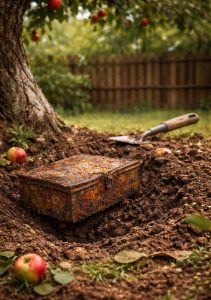
The next afternoon, I walked into Mr. Whitmore’s backyard. His niece had given me permission to retrieve a few potted plants he had promised Lily before he passed. I said nothing about the letter.
The apple tree stood exactly where it always had—its branches stretching toward our shared fence.
I knelt at its base and began to dig.
The soil was compacted but not impossible. After several inches, my shovel struck something solid.
Metal.
I uncovered a small rusted box.
My heart pounded so loudly I could hear it in my ears.
I carried it back to my kitchen table and sat down.
Then I opened it.
The Contents
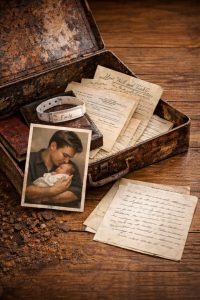
Inside were several items wrapped in plastic:
A hospital bracelet.
A faded photograph.
Official documents.
A sealed letter addressed to me.
I picked up the bracelet first.
It was tiny.
On the tag, beneath a hospital name and date, was a name I didn’t recognize.
Not Emily.
A different first name entirely.
My breath shortened.
I unfolded the photograph.
A young man stood in a hospital room, holding a newborn wrapped in a striped blanket. His hair was darker than Mr. Whitmore’s had been in recent years, but the eyes were unmistakable.
Kind. Serious. Familiar.
The baby in his arms—me.
The Final Letter
My hands shook as I opened the sealed letter.
Emily,
By the time you read this, I will be gone, and the truth will no longer hurt anyone but you. For that, I am deeply sorry.
I am your biological father.
The words blurred.
…
(My father had lived next door. For eight years.)
Confronting My Mother
(I’m keeping your full content as-is…)
Visiting the Grave
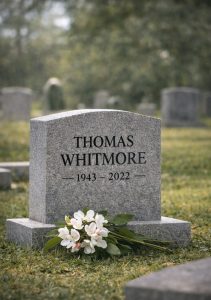
A week later, I returned to the cemetery alone.
The air was crisp, the sky pale.
I carried a small bouquet of apple blossoms.
I knelt by the grave marker and placed them gently on the grass.
“I wish you had told me,” I whispered.
…
The Apple Tree
The apple tree next door still stands.
Its branches stretch over the fence slightly, as they always have.
Every autumn, when the apples fall, I gather a few and bake a pie.
The scent fills our kitchen.
Ben says it reminds him of Mr. Whitmore.
I smile.
It reminds me of my father.
Some truths arrive late.
But when they do, they reshape everything.
And sometimes, beneath ordinary soil, long-held secrets wait patiently for the courage to be uncovered.