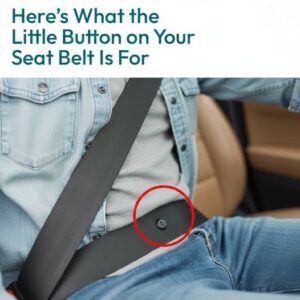
If you’ve ever taken a close look at the seat belt in your car, you may have noticed a small plastic button attached to the belt itself. It’s usually positioned somewhere between the shoulder area and the metal latch plate that clicks into the buckle.
For most drivers and passengers, this tiny component goes completely unnoticed.
Even if someone does see it, they often assume it’s just a decorative part of the belt or a random piece of plastic with no real purpose.
But that small button actually plays an important role in the everyday function of your seat belt.
In fact, without it, using your seat belt could become far more frustrating.
This tiny component is called the seat belt stop button, and while it may look insignificant, it helps ensure that one of your car’s most important safety systems works smoothly every time you use it.
Understanding what this small feature does can give you a better appreciation of how thoughtfully modern vehicles are designed.
A Quick Look at How Seat Belts Work
To understand the purpose of the stop button, it helps to first understand how seat belts operate.
Seat belts are designed to keep passengers securely positioned in their seats during sudden stops, sharp turns, or collisions. They work by distributing the force of a crash across stronger parts of the body such as the chest and hips.
Most modern vehicles use a three-point seat belt system. This system includes three main components:
-
The shoulder strap, which crosses the chest
-
The lap belt, which sits across the hips
-
The latch plate, which inserts into the buckle
When you pull the belt across your body and click it into place, an internal retractor mechanism keeps the belt snug while still allowing small movements.
If the vehicle suddenly stops or crashes, the retractor locks the belt in place to prevent the passenger from moving forward.
This system has saved millions of lives since it became widely adopted in vehicles around the world.
But even such a well-designed system needs small components to ensure it functions conveniently.
That’s where the stop button comes in.
What the Seat Belt Stop Button Actually Does
The seat belt stop button has one simple but important job:
It prevents the latch plate from sliding too far down the seat belt.
Without this button, the metal latch plate could slide all the way down the belt when the belt retracts into the pillar of the car.
That would cause several problems.
For example, the latch could end up near the floor of the vehicle, making it harder for the next passenger to reach it.
Instead of being positioned conveniently near your shoulder or chest, the latch might require you to pull out the entire belt just to find it.
The stop button keeps the latch plate in a consistent position along the belt so it’s always easy to grab.
In short, it’s a small convenience feature that makes using your seat belt much smoother.
Why This Small Button Matters
At first glance, it may seem like a minor detail.
After all, the seat belt would still technically work even if the latch plate slid farther down the belt.
However, small design details can make a big difference in everyday usability.
Imagine entering a car where the seat belt latch has slipped all the way down toward the floor.
You would need to pull out the belt, search for the latch, reposition it, and then buckle up.
This extra step might seem minor, but over time it could discourage some passengers from wearing their seat belts properly.
Vehicle designers aim to remove these small inconveniences so that using safety equipment becomes automatic and effortless.
The stop button ensures that the latch plate stays exactly where drivers and passengers expect it to be.
Where You’ll Usually Find the Stop Button
In most vehicles, the seat belt stop button is located somewhere along the upper section of the belt.
You’ll typically see it:
-
A few inches above the latch plate
-
Along the shoulder portion of the belt
-
Between the latch and the seat belt guide
It’s usually made from durable plastic and is attached through the belt with a small pin-like connector.
Because it’s lightweight and compact, many people never notice it unless it breaks or falls off.
But once you know what to look for, you’ll probably spot it immediately.
Check your car’s seat belt and you’ll likely see the small circular button sitting quietly on the strap.
A Simple Solution to a Common Problem
The idea behind the seat belt stop button is surprisingly simple.
Engineers realized that retracting seat belts naturally pull the latch plate downward.
Without something to stop it, the latch could slide along the belt until it reached the lowest possible point.
Adding a small stopper solved the issue instantly.
The button acts as a barrier that prevents the latch plate from sliding any farther.
Because it’s so small and inexpensive, it became a standard feature in modern seat belt designs.
Today, almost every vehicle includes some version of this simple device.
What Happens If the Stop Button Breaks?
Like any small component, the seat belt stop button can occasionally break or fall off.
This might happen due to wear over time, rough handling, or simple aging of the plastic material.
When the button is missing, the latch plate may begin sliding freely along the belt.
This can cause a few minor inconveniences.
For example:
-
The latch may slide down toward the floor
-
It may become harder to grab when entering the vehicle
-
The belt may twist more easily
Fortunately, this problem is not dangerous in most cases.
The seat belt itself will still function properly during normal driving and even during a crash.
However, replacing the stop button can restore the belt’s convenient positioning.
How Easy It Is to Replace a Stop Button
One of the best things about seat belt stop buttons is how easy they are to replace.
Many auto parts stores sell simple replacement kits designed specifically for this purpose.
These kits typically include two plastic pieces that snap together through the seat belt fabric.
Installing one usually takes only a few minutes.
The process generally involves:
-
Positioning the two halves of the replacement button on opposite sides of the belt
-
Aligning the center pins
-
Pressing the pieces together until they lock in place
Some kits may require a small tool or pliers, but the process is still quick and straightforward.
Even someone with minimal mechanical experience can usually complete the replacement without difficulty.
Why Seat Belt Maintenance Is Important
Although the stop button itself is a minor component, it’s part of a much larger safety system.
Seat belts are one of the most effective safety features ever developed for vehicles.
According to transportation safety organizations, wearing a seat belt significantly reduces the risk of serious injury or death in car accidents.
Because of this, it’s important to keep your seat belts in good condition.
Regularly checking your seat belts can help identify potential issues such as:
-
Fraying or worn fabric
-
Stuck retractors
-
Twisted belts
-
Damaged latch plates
-
Missing stop buttons
Addressing small problems early helps ensure that your seat belt system continues to operate properly.
The Engineering Behind Small Car Details
Modern vehicles contain thousands of carefully designed components.
Some of them, like engines and braking systems, receive a lot of attention.
Others are so small that drivers rarely think about them.
Yet these small details are often the result of thoughtful engineering.
The seat belt stop button is a perfect example.
Engineers recognized a minor inconvenience and created a simple, affordable solution.
That small improvement helps millions of drivers and passengers buckle their seat belts more easily every day.
Why People Often Miss Small Features
Human attention naturally focuses on larger or more obvious elements.
When entering a car, people typically notice things like the steering wheel, dashboard, or seats.
Tiny features like seat belt buttons fade into the background.
Because these parts work quietly without drawing attention, they often go unnoticed for years.
But once someone learns about them, they suddenly become much easier to spot.
Many drivers are surprised when they discover that this small button has been sitting right next to them the entire time.
Other Small Car Features With Hidden Purposes
The stop button isn’t the only small car feature that serves an important role.
Modern vehicles include many subtle design elements that improve safety and convenience.
Examples include:
-
Small arrows on the fuel gauge that indicate which side the gas cap is on
-
Headrest posts designed to break windows during emergencies
-
Tiny drainage holes in doors to prevent water buildup
-
Hidden hooks for hanging grocery bags in trunks
These details often go unnoticed, but they make driving safer and more convenient.
Automotive engineers spend years refining these small features to improve the overall driving experience.
A Good Reminder About Everyday Technology
The story of the seat belt stop button offers a useful reminder.
Many everyday objects around us include thoughtful design elements that we rarely notice.
From kitchen appliances to smartphones to cars, countless small components quietly perform important functions.
When we take a closer look at these details, we often discover clever solutions hidden in plain sight.
The seat belt stop button may be tiny, but it represents a smart design choice that improves convenience and usability.
Next Time You Buckle Up, Take a Look
The next time you get into your car, take a moment to examine your seat belt more closely.
Look along the strap near the latch plate.
You’ll likely see the small circular stop button attached to the belt.
Now that you know its purpose, that tiny piece of plastic may seem a little more interesting than before.
It’s a reminder that even the smallest parts of our daily tools are often designed with careful thought.
And while it may be easy to overlook, that little button plays a helpful role in making sure your seat belt is always right where you need it.
Small, simple, and easy to miss—but surprisingly useful every single day.