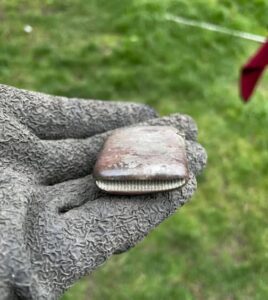
For those who look back fondly on earlier times—or enjoy collecting reminders of the past—the vintage vesta case offers a fascinating blend of charm, history, and practicality. At first glance, it might appear to be nothing more than a small, weathered metal box. Many people would overlook it entirely if they saw it in a drawer, at a flea market, or buried in a box of old belongings.
Yet objects like this often carry a remarkable story.
A rusty old vesta case may seem insignificant in today’s world of disposable lighters and electronic gadgets, but during the late 19th and early 20th centuries it was a daily necessity. These tiny containers protected one of the most important tools of everyday life: matches. In a time when lighting a lamp, stove, cigar, or lantern required a flame, having dry and safe matches was essential.
Collectors today prize these little containers not only for their historical value but also for their craftsmanship. Each one reflects the design sensibilities of its era, the materials available at the time, and the personal habits of the people who once carried them.
What looks like a rusty trinket might actually be a collectible artifact worth far more than expected.
What Is a Vesta Case?
A vesta case, sometimes called a match safe, is a small container designed to hold friction matches. The name “vesta” comes from Vesta, the Roman goddess associated with the home, fire, and domestic life. The name was fitting because the purpose of the object was to keep the flame—symbolized by matches—protected and ready for use.
These cases became widely popular during the 1800s and early 1900s, particularly after friction matches became common household items. Matches revolutionized how people produced fire. Instead of striking flint or using complicated methods, one quick strike could create a flame instantly.
However, early matches were not as safe as modern versions. They could ignite accidentally if exposed to friction, moisture, or heat. Carrying loose matches in a pocket was risky. A protective container solved that problem.
The vesta case was the perfect solution.
Most were small enough to fit comfortably in a pocket or purse, and many included a textured strip or ridged surface used to strike matches. This meant a person could carry matches and ignite them using the same device.
In essence, the vesta case was both storage and tool, combining convenience with safety.
Designed for Style and Safety
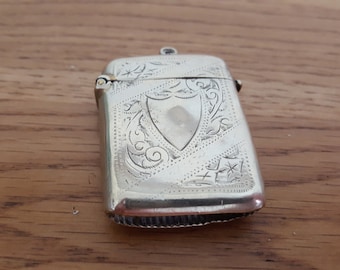
Although they served a practical purpose, vesta cases were often beautifully designed.
Craftsmen produced them using a wide range of materials, including:
-
Sterling silver
-
Brass
-
Pewter
-
Copper
-
Enamel
-
Gold-plated metals
More luxurious examples were crafted from ivory, tortoiseshell, or decorated with intricate enamel artwork. Wealthy owners sometimes commissioned custom cases engraved with monograms, family crests, or decorative motifs.
Even the simpler versions were carefully made.
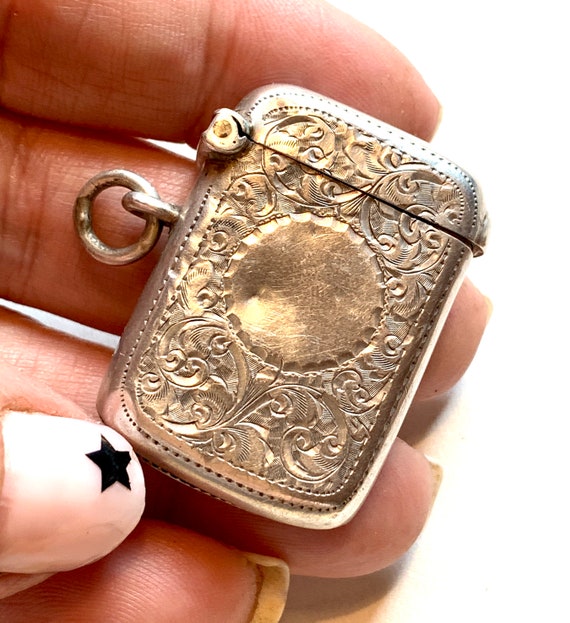
Many vesta cases featured a small loop at the top, allowing the owner to attach them to a chain, belt, or watch fob. This kept the case secure and easily accessible. Men frequently attached them to pocket watch chains, while women sometimes carried them in handbags or chatelaines—decorative waist chains used in Victorian fashion.
The match striker—an essential feature—was usually located on the bottom or side of the case. It appeared as a rough strip of metal designed to ignite friction matches.
This thoughtful design meant that the case protected matches from moisture while also functioning as a striking surface.
Durability mattered as well. These objects were built to withstand daily use. Hinges were sturdy, metal was thick, and craftsmanship was precise. Many examples from the 1800s still function perfectly today.
A Peek Into Everyday Life

To understand the significance of a vesta case, it helps to imagine daily life in the late 19th century.
Fire was central to everyday routines.
People relied on matches to:
-
Light oil lamps
-
Ignite coal stoves
-
Start fireplaces
-
Light cigars and pipes
-
Illuminate lanterns
In homes without electricity, lighting a room meant lighting a flame. In cold climates, starting a stove was essential for warmth. Even outdoor activities such as camping, hunting, or traveling depended on reliable fire.
Because of this, matches were carried everywhere.
A person might keep a vesta case in a coat pocket, waistcoat, handbag, or travel bag. Some were worn like accessories, dangling from watch chains alongside small tools or charms.
In many ways, the vesta case was the everyday carry item of its time—similar to how people today carry smartphones, lighters, or keychains.
These cases also reflected social status. Wealthy individuals often owned elaborately decorated versions, while working-class people used simpler metal ones.
But regardless of design, the function was the same: keeping matches safe and accessible.
Vesta Cases and the Industrial Age
The popularity of vesta cases coincided with the rapid industrial expansion of the 19th century.
Factories were producing matches on a large scale, making them affordable for ordinary people. As matches became widely available, the need for safe storage increased.
Manufacturers began producing vesta cases in huge quantities.
Some were mass-produced, while others remained handcrafted. Jewelry makers, silversmiths, and metalworkers all contributed to the growing market.
In cities across Europe and North America, vesta cases became a common item sold in:
-
Hardware shops
-
Tobacco stores
-
Jewelry shops
-
Street markets
The rise of consumer culture meant people wanted practical objects that also expressed individuality. Vesta cases fulfilled both needs.
Personal Engravings and Hidden Stories
One of the most fascinating aspects of antique vesta cases is the personal history they often carry.
Many examples feature engraved initials, dates, or decorative patterns. These markings sometimes reveal clues about their original owners.
Some were given as gifts to commemorate:
-
Birthdays
-
Weddings
-
Military service
-
Professional achievements
During wartime, soldiers sometimes carried vesta cases as practical tools. Some even engraved them with regimental symbols or battle dates.
Holding such an object today can feel like touching a fragment of someone else’s life.
Each scratch, dent, or engraving tells a story.
Military Connections
Vesta cases also appeared on battlefields during major conflicts.
Soldiers needed fire for cooking, lighting lanterns, or starting signal fires. A durable match safe was invaluable in harsh conditions.
During World War I and World War II, personal items like vesta cases traveled with troops across continents.
Some military examples include engraved insignias or patriotic designs. Others show signs of heavy use, dents, and repairs made in the field.
Collectors today often seek these pieces because they connect everyday objects to major historical events.
The Rise of Collecting
In recent decades, antique collectors have rediscovered the appeal of vesta cases.
Their small size makes them easy to store and display, while their variety keeps the hobby interesting. Some collectors specialize in particular materials or designs.
Popular categories include:
-
Sterling silver cases
-
Novelty shapes
-
Advertising vesta cases
-
Military-themed designs
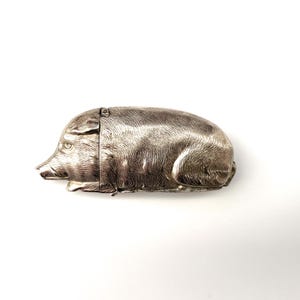
Novelty versions are especially fascinating. Some were shaped like animals, shoes, books, or miniature tools. Others featured moving parts or hidden compartments.
These unusual designs can be highly valuable.
Certain rare examples sell for hundreds or even thousands of dollars at auctions, depending on condition, craftsmanship, and rarity.
Cleaning and Preserving Antique Vesta Cases
If you happen to find a vintage vesta case—perhaps in a drawer, flea market, or estate sale—it’s important to handle it carefully.
Collectors recommend gentle cleaning methods.
Use a soft cloth to remove surface dirt or dust. Avoid harsh chemicals or abrasive polishing compounds. These can remove the natural patina that gives antique metal its character.
Patina is not damage.
In fact, it often increases the historical value of an object.
A lightly aged surface tells a story of time and use. Removing it can reduce both the collectible appeal and monetary value.
If the case is sterling silver, mild polishing may be appropriate, but it should be done carefully and sparingly.
Where People Still Find Them
Antique vesta cases occasionally appear in surprising places.
Collectors report discovering them at:
-
Estate sales
-
Antique markets
-
Flea markets
-
Online auctions
-
Metal detecting sites
Sometimes they are uncovered in fields, gardens, or abandoned homesteads where people lived generations ago.
Because they were small and durable, many survived long after other objects deteriorated.
Finding one can feel like discovering a tiny time capsule.
Why These Small Objects Fascinate Us
In a world dominated by disposable products, objects like vesta cases remind us of a different era.
They represent a time when everyday tools were built with care, durability, and style. Even simple items were crafted to last decades.
People repaired them, polished them, and sometimes passed them down through generations.
That philosophy contrasts sharply with modern consumer habits.
Today, many objects are designed to be replaced quickly. But vesta cases were meant to endure.
Their survival into the present day proves the value of thoughtful craftsmanship.
The Emotional Appeal of Antique Objects
Another reason vesta cases capture people’s imagination is the emotional connection they create.
Holding one can spark curiosity:
Who carried it?
Where did it travel?
What stories might it tell?
Antiques often bridge the gap between past and present. They allow us to imagine the lives of people who lived decades—or even centuries—before us.
Unlike museum artifacts locked behind glass, a vesta case is small enough to hold in your hand. That tactile experience makes history feel more personal.
The Craftsmanship Behind the Design
The craftsmanship of antique metalwork is another reason collectors value vesta cases.
Victorian-era artisans paid careful attention to details. Hinges were precisely aligned, surfaces carefully engraved, and materials selected for durability.
Even simple brass models were made with skill.
In more elaborate versions, silversmiths created intricate engravings that resembled miniature works of art.
This level of craftsmanship is increasingly rare in modern mass-produced objects.
Are They Valuable?
The value of a vintage vesta case varies widely depending on several factors.
Collectors usually consider:
-
Material
-
Age
-
Condition
-
Rarity
-
Design
A basic brass case might sell for modest prices, while rare sterling silver or novelty versions can command significantly higher amounts.
Cases with historical engravings or unusual shapes are particularly desirable.
Even if a case is not extremely valuable financially, its historical and artistic significance can still be remarkable.
Why People Love These Relics
Ultimately, the appeal of a vintage vesta case goes beyond money.
It represents an era when everyday objects were designed with intention and pride. These cases were not disposable accessories—they were tools people relied on daily.
They carried them everywhere.
They refilled them, reused them, and sometimes passed them along to family members.
That sense of permanence and craftsmanship gives vesta cases a timeless charm.
A Small Object With a Big Story
When you hold a vesta case today, you’re holding more than a container for matches.
You’re holding a piece of social history.
It reflects how people lived, how they traveled, and how they interacted with the technologies of their time. It reveals the importance of fire in daily life and the creativity of artisans who transformed a simple utility item into something beautiful.
Small objects often tell the biggest stories.
Final Thoughts
A rusty little metal case might not look impressive at first glance.
But when you understand its history, design, and cultural role, it becomes something far more meaningful.
The vintage vesta case represents practicality, craftsmanship, and the human desire to combine beauty with everyday function.
For collectors, historians, and curious observers alike, these tiny artifacts serve as reminders that even the simplest objects can carry extraordinary stories.
So the next time you encounter an old metal case at a flea market or tucked away in a forgotten drawer, take a closer look.
It might just be worth far more—historically and perhaps financially—than you ever imagined.