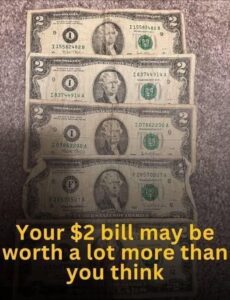
For most Americans, paper currency feels routine—something exchanged every day at grocery stores, restaurants, and gas stations. Yet occasionally, an ordinary-looking bill can hold unexpected value. The $2 bill is one of the most fascinating examples.
Although still legal tender in the United States, the $2 bill occupies a curious place in American financial culture. Many people rarely see one, some believe it’s no longer printed, and others treat it as a novelty item. But in certain cases, a $2 bill can be worth far more than its face value to collectors.
Understanding why requires a closer look at the history of the denomination, the characteristics collectors search for, and the economic forces that drive the rare currency market. Whether you’re interested in collectible currency, rare U.S. banknotes, or simply curious about what might be hiding in your wallet, the $2 bill offers a surprising lesson in American financial history.
The Hidden Meaning / Significance
Why the $2 Bill Fascinates Americans
Few pieces of American currency carry as much mystique as the $2 bill. Unlike commonly circulated bills such as $1, $5, or $20 denominations, the $2 bill appears infrequently in everyday transactions. This rarity has fueled decades of myths and misconceptions.
In reality, the $2 bill remains part of the U.S. monetary system and continues to be printed periodically by the Bureau of Engraving and Printing, a division of the U.S. Department of the Treasury. However, its low demand means that fewer are produced compared with other denominations.
Because people encounter them so rarely, many assume they are discontinued or rare collectibles by default. Ironically, this belief causes people to save them rather than spend them—making them circulate even less.
You might not realize that this simple behavioral pattern has helped transform the $2 bill from ordinary currency into an object of curiosity and collectible interest.
Symbolism in American Currency
The $2 bill also carries symbolic significance. The modern design features Thomas Jefferson, the third president of the United States, on the front and a depiction of the signing of the Declaration of Independence on the reverse. This artwork is based on John Trumbull’s famous painting housed in the U.S. Capitol Rotunda.
Because Jefferson played such a central role in American independence, the bill quietly celebrates a foundational moment in U.S. history. For collectors and historians, this historical connection adds cultural depth beyond the bill’s monetary value.
Scarcity vs. Perceived Rarity
A key factor driving interest in the $2 bill is the difference between actual scarcity and perceived rarity.
While millions of $2 bills exist, their limited circulation means most Americans rarely encounter them. This creates the illusion that they are scarce. In reality, only certain types—such as older series, unusual serial numbers, or printing errors—are genuinely rare.
The psychology behind perceived rarity plays a major role in collectible markets, from numismatics (coin collecting) to rare stamps and vintage trading cards. The $2 bill sits squarely within this phenomenon.
Practical Implications for People, Consumers, and Businesses
How to Tell if a $2 Bill Is Valuable
If you find a $2 bill tucked away in a drawer, wallet, or old envelope, it’s worth examining it carefully before spending it. Several characteristics determine whether a bill might interest collectors.
Check the Series Year
The series year printed on the bill indicates when its design was issued. While many modern bills date from 1976 onward, earlier series can be significantly more valuable.
Examples include:
-
1890–1918 Large Size Notes
-
1928–1963 Red Seal Notes
-
1976 Bicentennial Series
Older bills are often larger in size and may feature different seal colors or design elements.
Examine the Seal Color
The color of the Treasury seal on the bill is another important detail.
Common seal colors include:
-
Green Seal: Modern Federal Reserve Notes
-
Red Seal: Older United States Notes
-
Brown Seal: National banknotes issued by specific banks
Collectors often pay premiums for red-seal notes because they represent earlier currency systems.
Look at the Serial Number
Serial numbers are one of the most exciting aspects for collectors. A bill with an unusual serial number can be worth far more than its face value.
Examples include:
-
Low serial numbers (e.g., 00000025)
-
Repeating numbers (e.g., 77777777)
-
Ladder patterns (e.g., 12345678)
-
Radar numbers (e.g., 12344321)
-
Solid numbers (e.g., 55555555)
These patterns are rare and highly desirable among collectors of paper currency.
Evaluate the Condition
Condition is crucial in determining value. Collectors generally categorize banknotes using a grading system similar to coins.
Typical grades include:
-
Poor or Good: heavily worn
-
Fine: moderate wear
-
Very Fine: minor wear
-
Extremely Fine: nearly new
-
Uncirculated: crisp with no folds
An uncirculated $2 bill with a unique serial number can sometimes sell for hundreds—or even thousands—of dollars depending on rarity.
Why Businesses Rarely Use $2 Bills
Despite being legal tender, $2 bills are rarely seen in retail environments. There are several practical reasons.
First, cash registers are typically designed with slots for the most common denominations. Because $2 bills appear so infrequently, many businesses simply do not allocate drawer space for them.
Second, employees unfamiliar with the bill sometimes hesitate to accept it, fearing counterfeit currency. This hesitation reinforces the perception that the bill is unusual or outdated.
Finally, consumer habits play a role. Since most people prefer to keep them as souvenirs, fewer $2 bills circulate in everyday commerce.
The Collectible Currency Market
The market for collectible currency—often referred to as the rare banknote market—is surprisingly robust. Collectors around the world actively buy and sell historic American notes through auctions, specialty dealers, and online platforms.
According to the American Numismatic Association, interest in collectible currency has grown steadily in recent decades, driven by online marketplaces and expanding hobby communities.
Some rare banknotes have sold for tens of thousands of dollars, particularly those with historical significance, limited print runs, or dramatic printing errors.
While most $2 bills will never reach such high prices, the possibility adds excitement to searching through old currency.
Historical / Cultural Context
The Origins of the $2 Bill
The $2 bill was first introduced in 1862 during the American Civil War, a period when the federal government dramatically expanded paper currency to finance wartime expenses.
Early versions featured Alexander Hamilton, who later appeared on the $10 bill. Over time, the design changed to feature Thomas Jefferson instead.
These early banknotes were part of the government’s efforts to standardize the national currency system.
Changes in Design and Format
The size of American currency changed significantly in 1928 when the U.S. Treasury standardized banknote dimensions. Earlier “large-size” notes were physically larger than modern bills.
The $2 bill went through several design changes:
-
1862–1918: Large-size notes with elaborate engravings
-
1928–1963: Smaller red-seal notes
-
1976: Bicentennial redesign with Declaration of Independence artwork
The 1976 series was released to commemorate the United States Bicentennial, marking 200 years since the signing of the Declaration of Independence.
Millions of Americans kept these bills as souvenirs, which ironically reduced their circulation even further.
Superstitions and Myths
Throughout the 20th century, the $2 bill developed a reputation for bad luck. Some believed it was associated with gambling or corruption, while others thought it brought misfortune.
Historians note that such myths likely emerged from cultural habits rather than factual evidence. In many cases, people simply felt uncomfortable using a denomination they rarely encountered.
These myths persisted for decades, reinforcing the bill’s unusual status in American culture.
Pop Culture and the $2 Bill
The $2 bill has also appeared frequently in American pop culture.
Some notable examples include:
-
Casinos using $2 bills for tips
-
Tourists collecting them as souvenirs
-
Businesses distributing them as promotional items
Because they are distinctive, the bills often attract attention when used in everyday transactions.
Tips, Insights, or Takeaways
Always Check Your Cash
If you come across a $2 bill—especially in an old wallet, envelope, or inherited collection—it’s worth taking a closer look. While most are worth exactly two dollars, certain features can dramatically increase their value.
Look for:
-
Older series dates
-
Unusual serial numbers
-
Printing errors
-
Excellent condition
Even a modest collector premium can make the bill more valuable than spending it.
Protect Valuable Currency
If you believe you have a valuable banknote, proper storage is important. Currency collectors recommend:
-
Keeping bills in protective sleeves
-
Avoiding folding or handling excessively
-
Storing them in a cool, dry place
These precautions help preserve condition, which directly affects value.
Consider Professional Appraisal
For potentially valuable notes, professional evaluation may be worthwhile. Currency grading services and certified dealers can determine authenticity and condition.
Some of the most respected organizations in the hobby include:
-
The American Numismatic Association
-
Professional currency grading companies
-
Licensed rare currency dealers
Professional grading can significantly increase buyer confidence if you decide to sell.
Understand the Difference Between Curiosity and Rarity
Not every unusual-looking bill is valuable. While collectors appreciate unique serial numbers or older designs, the majority of $2 bills remain common.
Learning the basics of currency collecting helps distinguish between novelty and genuine rarity.
Additional Insights: The Economics of Collectible Currency
Why Rare Currency Gains Value
The value of collectible currency depends on several economic principles:
-
Scarcity – fewer surviving examples increase value
-
Demand – collector interest drives prices upward
-
Condition – pristine notes command premiums
-
Historical significance – notes tied to major events attract collectors
These factors combine to create a dynamic market where certain banknotes can appreciate over time.
Inflation and Tangible Assets
During periods of inflation or economic uncertainty, tangible assets often gain attention as alternative stores of value.
While collectible currency is not typically considered a traditional investment like stocks or real estate, some collectors view rare notes as long-term collectibles with potential appreciation.
This perspective overlaps with broader trends in alternative assets, which include rare coins, artwork, vintage watches, and collectible memorabilia.
Digital Payments vs. Physical Currency
Another factor influencing interest in paper currency is the rise of digital payments. As Americans increasingly use credit cards, mobile wallets, and online banking, physical cash becomes less common in everyday life.
Paradoxically, this shift can increase the appeal of historical currency. As fewer people handle paper money regularly, collectible banknotes become reminders of earlier financial systems.
Conclusion
The $2 bill occupies a unique place in American financial history. Though still legal tender, it is rarely seen in everyday transactions, creating an aura of mystery and fascination. For collectors, certain versions—particularly older notes, unusual serial numbers, or printing errors—can be worth far more than their face value.
For the average person, the lesson is simple: pay attention to the small details. A seemingly ordinary piece of currency could turn out to be a collectible item with historical significance or unexpected value.
The next time you encounter a $2 bill, take a moment to examine it closely. While most will remain worth exactly two dollars, a few hidden gems continue to circulate quietly—waiting for someone observant enough to recognize their significance.