In the age of smart appliances and sleek kitchen gadgets, it’s easy to forget that many everyday tools once looked—and functioned—very differently. Recently, a curious discovery shared online reminded thousands of people just how much kitchen technology has evolved over time.
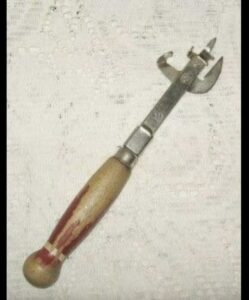
The story began with a simple post on an online forum. Someone cleaning out a relative’s home came across an unusual metal object tucked away in a kitchen drawer. At first glance, the item didn’t resemble any modern kitchen tool. Its pointed metal tip, sharp edges, and sturdy lever-like shape made it look more like something from a workshop than a cooking space.
Confused but curious, the person uploaded a photo and asked a straightforward question: What exactly was this thing?
Within hours, the internet responded with its trademark mixture of speculation, humor, and historical knowledge. The mysterious tool sparked a wave of guesses, memories, and conversations about how people once opened canned food long before today’s smooth, easy-to-use devices.
What many users eventually realized was that the puzzling object wasn’t a weapon, camping gear, or fishing tool at all. It was something far more familiar—just from a different era.
It was a vintage can opener.
What might seem like a simple discovery actually opened the door to a fascinating look at the history of food preservation, kitchen design, and how everyday tools have changed over generations.
The Online Mystery That Sparked Curiosity
When people share unusual objects online, the reactions often follow a familiar pattern. Some users quickly identify the item, while others throw out imaginative guesses. In this case, the strange tool sparked both reactions.
The original poster explained they had discovered the metal object while sorting through items in their grandmother’s kitchen. It was stored alongside ordinary utensils, which suggested it had once been used for cooking or food preparation.
However, the design looked unfamiliar to anyone accustomed to modern kitchen tools.
Unlike contemporary can openers, which typically feature rotating wheels and ergonomic handles, this device looked rugged and somewhat intimidating. Its pointed blade appeared designed to puncture something, while a curved edge hinted at a prying or cutting motion.
Some people were confident they knew what it was right away. Others weren’t so sure.
Theories poured in.
A few users suggested it might be an antique fishing tool. Others wondered whether it could be a camping gadget used for opening tins outdoors. Some joked that the item looked sturdy enough to belong in a toolbox rather than a kitchen.
Eventually, several experienced users recognized the object for what it truly was: an early-style can opener that required a very different technique than the tools we use today.
Their identification sparked a flood of nostalgia.
Many people who had grown up using similar tools shared stories about them—stories that ranged from humorous to slightly painful.
When Kitchen Tools Were Less Forgiving
For many people who remember these vintage can openers, the memories include both appreciation and caution.
Unlike modern designs, early can openers often required significant hand strength and careful control. The user would puncture the metal lid of a can and then move the tool forward step by step, cutting the top away gradually.
It worked, but it wasn’t exactly effortless.
Because the metal lids were thick and the cutting motion was manual, the process could sometimes leave jagged edges along the rim of the can. Those edges could be surprisingly sharp if someone wasn’t careful.
Older generations often recall learning how to use these tools as part of everyday kitchen routines. Opening canned vegetables, soups, or fruit might require patience and a steady hand.
For people who grew up with modern appliances, this process can seem surprisingly challenging. Today’s kitchen tools prioritize convenience, safety, and ease of use, but earlier designs focused primarily on function.
If the tool could get the job done, that was often enough.
The Surprising History of Canned Food
To understand why early can openers looked the way they did, it helps to look back at the origins of canned food itself.
The concept of preserving food in sealed containers dates back to the early 19th century. Before refrigeration became common, keeping food fresh for long periods was a major challenge.
Governments and explorers alike wanted ways to store meals that could survive long journeys.
In 1810, a French inventor named Nicolas Appert developed one of the first successful food preservation methods using sealed glass containers heated to prevent spoilage. His work eventually led to the development of metal cans, which proved more durable for transportation and military use.
However, early canned food came with an unexpected problem.
The containers were incredibly strong.
So strong, in fact, that manufacturers initially assumed people would open them using tools like hammers and chisels. Instructions printed on early cans sometimes suggested exactly that approach.
As you might imagine, this method wasn’t particularly convenient—or safe.
For decades, people relied on whatever tools they had available to break into canned food.
It wasn’t until later that inventors began developing devices specifically designed to open these containers more efficiently.
The First Dedicated Can Opener
In 1858, American inventor Ezra Warner introduced one of the first tools designed specifically to open cans.
Warner’s design featured a sharp blade that pierced the metal lid and a guard that helped control the depth of the cut. The user would puncture the lid and then work the tool around the rim, cutting the metal open.
Although the design was effective, it wasn’t especially refined.
It required careful handling, and the exposed blade meant users needed to pay attention while operating it. Still, it was a major improvement over chisels and hammers.
Because canned food was especially important for feeding soldiers, Warner’s invention gained attention from the military. His opener was used during the American Civil War to help soldiers access preserved rations more easily.
However, the design was still somewhat cumbersome for everyday household kitchens.
Inventors continued searching for ways to make the process smoother and safer.
A Major Improvement Arrives
A significant step forward came in 1870 when another inventor, William Lyman, introduced a new style of can opener.
Instead of relying entirely on puncturing and prying, Lyman’s design used a rotating cutting wheel that moved around the rim of the can. This innovation allowed the tool to slice through the metal lid more evenly and efficiently.
The concept was similar to modern can openers, though the early versions still required careful positioning and manual control.
Over time, engineers improved the design further by adding gears, handles, and rotating mechanisms that made the cutting motion smoother.
By the early 20th century, can openers were becoming common household tools.
Yet even then, they were still quite different from the sleek devices found in kitchens today.
The Era of Keyed Cans
During the early 1900s, another interesting development appeared in the world of canned food: the keyed can.
Some products—especially items like sardines and processed meats—were packaged in cans that included a small metal key attached to the lid.
Instead of using a separate tool, the user would insert the key into a tab and twist it, rolling a strip of metal away from the top of the container.
This design eliminated the need for a separate opener entirely.
Keyed cans became popular for certain foods because they were convenient and compact. However, the design wasn’t suitable for all types of canned goods, so traditional openers remained necessary in most kitchens.
The Arrival of Electric Convenience
As household appliances evolved during the 20th century, inventors began experimenting with ways to automate common kitchen tasks.
By the 1930s, the first electric can openers began appearing on the market.
These devices used small motors to rotate the cutting wheel automatically, reducing the amount of effort required from the user.
Early electric models were often bulky and expensive, but the concept proved popular. Over the following decades, manufacturers refined the design and made electric openers more compact and affordable.
By the mid-20th century, many homes included either a handheld rotary opener or an electric version mounted on a countertop.
At the same time, improvements in metal manufacturing allowed cans to become slightly thinner and easier to cut, further simplifying the process.
Modern Can Openers: Safety and Simplicity
Today’s can openers reflect decades of engineering improvements focused on convenience and safety.
Most modern handheld openers use a rotating wheel that grips the edge of the can and slices through the lid smoothly. Many designs leave a relatively smooth rim rather than a jagged edge, reducing the chance of accidental cuts.
Some models even lift the lid away using magnets, keeping hands safely away from sharp surfaces.
Electric openers have also continued to evolve, with sleek designs that operate quietly and require minimal effort from the user.
In addition, many kitchens now include multi-function appliances that incorporate can-opening features alongside other tools.
Compared to early designs, modern openers feel effortless.
But that convenience sometimes makes people forget how much work earlier tools required.
Why Vintage Tools Still Fascinate People
When unusual items from the past appear online, they often capture attention for the same reason: they offer a glimpse into everyday life from another time.
Vintage tools show how people once solved practical problems with the materials and technology available to them.
A simple kitchen drawer from decades ago might contain gadgets that look unfamiliar today, even though they once served essential purposes.
For many people, discovering these objects sparks memories of grandparents’ homes, family kitchens, and routines that have gradually disappeared.
The vintage can opener that puzzled online users is a perfect example.
To someone who grew up using one, the tool is instantly recognizable.
To younger generations, however, it might look completely mysterious.
Nostalgia and Practicality
Interestingly, some people still prefer older kitchen tools.
Vintage can openers are often praised for their durability. Many were made from thick metal components designed to last for years, sometimes decades.
While modern tools emphasize lightweight materials and convenience, older designs sometimes feel sturdier in comparison.
That said, modern safety improvements have made today’s openers far easier to use.
The balance between nostalgia and practicality often shapes how people think about vintage kitchen equipment.
Some enjoy collecting old tools as historical artifacts, while others appreciate them as reminders of simpler times.
The Value of Identifying Everyday Objects
The online mystery surrounding the vintage can opener highlights something else as well: the internet has become an incredible resource for identifying unfamiliar items.
Communities dedicated to solving object mysteries regularly help people recognize tools, gadgets, and household items from previous generations.
These conversations often turn into unexpected lessons in history and design.
What begins as a simple question—“What is this?”—can lead to fascinating discoveries about how technology has evolved.
It also reminds people that many everyday conveniences we take for granted today were once innovative inventions themselves.
Lessons from a Simple Kitchen Tool
The story of the vintage can opener may seem small, but it reflects a larger truth about technology and progress.
Every object in our homes represents a series of design choices, experiments, and improvements made over time.
Kitchen tools in particular have undergone significant transformation as inventors worked to make cooking faster, safer, and more efficient.
From the earliest metal cans that required chisels to modern devices that open containers effortlessly, the journey shows how innovation often happens in gradual steps.
Each generation builds on the solutions of the one before it.
A Reminder That Everyday Objects Have Stories
The mysterious kitchen tool discovered in a drawer turned out not to be a weapon or a strange mechanical device.
It was simply a vintage can opener—a tool that once played an important role in everyday cooking.
Yet its unusual appearance sparked curiosity because it represented a design from another era.
Moments like this remind us that ordinary objects often carry surprising histories.
A simple utensil can reveal how people lived, cooked, and solved practical problems decades ago.
And sometimes, all it takes is a curious question online to bring that history back into the spotlight.
The Next Time You Open a Can
The next time you reach for a can opener in your kitchen, it might be worth taking a moment to appreciate how simple the process has become.
What now takes just a few seconds once required stronger tools, more effort, and a bit of patience.
Modern designs have made cooking easier and safer, but the earlier versions helped pave the way.
That small vintage tool discovered in a drawer may look unusual today, but it represents an important chapter in the evolution of everyday kitchen technology.
And like many objects from the past, it proves that even the most ordinary tools can tell fascinating stories when we take the time to look a little closer.\