It began as one of those ordinary Saturday afternoons that rarely leave a mark on memory. Richmond, Virginia was wrapped in late-summer heat.
The kind that makes asphalt shimmer and slows everything down just enough to feel heavy. The grocery store parking lot was full but unremarkable — carts rolling lazily across faded white lines.
Families unloading trunks, engines humming in the background. Nothing about that day suggested it would become one of the most defining moments of my life.
Inside the store, the air was cool and smelled faintly of citrus and baked bread. My wife, Danielle, stood in the produce aisle, gently turning peaches in her hands, inspecting each one with quiet care.
She has always done that — never rushing, never settling for less than what feels right. I watched her with a familiar sense of gratitude.
After more than thirty years together, that affection hasn’t dulled. If anything, it has deepened. To me, Danielle represents steadiness. Grace. A kind of strength that doesn’t announce itself.
I leaned against the cart, letting the world move around us. For a moment, everything felt calm. Normal. Safe.
Then something shifted.
It’s difficult to explain to someone who has never experienced it, but those who have served in high-stress environments know the feeling immediately.
It’s a subtle change — the air grows heavy, sounds sharpen, and your awareness narrows. You feel it before you see it. Years in the Marines trained my body to recognize danger long before my mind consciously names it.
A group of young men stood nearby. At first, they were laughing among themselves, voices casual and careless. Then their attention turned toward us. Their laughter changed — not louder, but sharper.
Their voices dropped into mocking tones, the kind meant to be shared just loudly enough to be heard. I glanced at Danielle.
She kept selecting fruit, her expression calm, practiced. We both understood the unspoken rule many people learn far too early: sometimes ignoring cruelty feels safer than confronting it.
At first, I hoped it would pass.
It didn’t.
The comments grew uglier. They mocked her skin color, using words designed to degrade, to assert dominance without consequences. Danielle did not respond. She never does.

Over the years, she has learned how to carry herself with dignity in the face of ignorance — not because it’s easy, but because she refuses to let hatred dictate her behavior. That kind of restraint comes at a cost, though. It accumulates quietly.
We finished our shopping and headed toward the exit, saying nothing. The automatic doors slid open, and the heat rushed back in. I thought that would be the end of it.
It wasn’t.
One of them followed us outside. His voice rang out across the parking lot — louder now, more aggressive. Another insult. Sharper. Meaner. And then, before either of us could react, he threw his drink at Danielle.
The splash of liquid and ice hitting the pavement sounded unnaturally loud. Time slowed. I saw the shock cross her face — then something far worse. Not fear. Not anger.
Exhaustion. The deep, familiar weariness of someone who has spent a lifetime absorbing other people’s hatred simply to exist in peace.
That was the moment everything crystallized.
In the Marines, we are taught that control is power. Not brute force. Not volume. Composure. You learn when to act and when not to. You learn that the ability to restrain yourself is often harder — and more important — than the ability to strike.
I felt my body respond before my thoughts caught up. I didn’t yell. I didn’t threaten. I turned around slowly and faced them.
They saw a middle-aged man with gray at his temples, wearing a worn leather jacket. What they did not see was twenty years of training — not just in combat, but in discipline.
They did not see the Marine who had learned how to read posture, intention, and fear. They did not understand that real strength doesn’t need to announce itself.
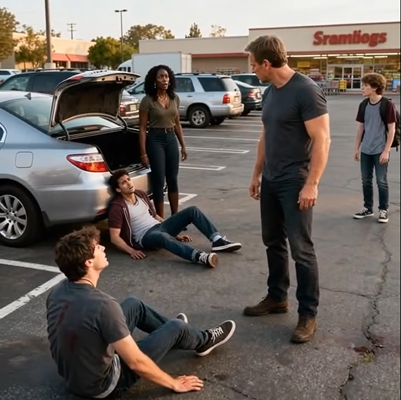
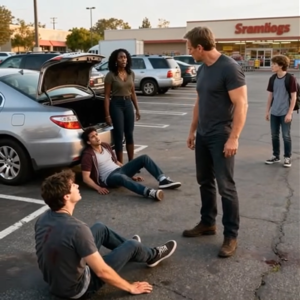
One of them stepped forward, puffing out his chest, trying to fill the space with false confidence. I took one step toward him — steady, deliberate. He reached out to shove me, telegraphing his movement without realizing it.
I redirected his momentum, guiding it away from me, and in a heartbeat he was on the ground. Not injured. Just stunned. The kind of stunned that comes when expectations collapse.
The others froze. One rushed forward to intervene and tripped over a shopping cart, crashing awkwardly to the pavement.
I never threw a punch. I never raised my voice.
I didn’t need to.
The message had already landed.
The parking lot fell silent. The laughter was gone. The arrogance evaporated. What remained was recognition — the sudden understanding that they had crossed a line and encountered something they didn’t know how to handle.
Store security arrived moments later, moving quickly, ready to intervene. Before I could speak, one of the young men stepped forward — the quiet one. He hadn’t joined in the insults.
His hands shook as he explained what had happened. He told the truth. He said his friends had mocked an innocent woman. He said I hadn’t attacked anyone. He said I had simply stopped it.
That moment mattered.
It took courage for him to speak when it would have been easier to stay silent. His words shifted the atmosphere. Tension eased. Accountability replaced chaos. The situation resolved without arrests, without escalation, without anyone getting seriously hurt.
Two days later, there was a knock at our front door.
When I opened it, that same young man stood there. His eyes were downcast. He held an envelope with both hands, gripping it tightly. His voice trembled as he spoke.
“Sir,” he said, “I came to apologize. Not just for them — but for me. I didn’t stop it when I should have.”
He handed me the envelope. Inside was a handwritten essay he had written for a college assignment. The title read: What I Learned About Strength.
He described what he had witnessed that day. Not violence. Not rage. Restraint. He wrote that he had expected a fight and instead saw something far more powerful — a man who had the ability to cause harm but chose not to. He wrote about how silence can be complicity, and how speaking up, even when afraid, matters.
That evening, I read the letter beside Danielle. She traced the edges of the page with her fingers, quiet for a long time. Then she looked at me and said softly, “Your calm taught him more than your fists ever could.”
She was right.
There are moments in life when anger feels justified — when every instinct demands retaliation. But true strength is not measured by how hard you can strike. It’s measured by discipline. By restraint. By the ability to choose peace when you have been trained for conflict.
That day didn’t end with applause. There were no headlines. No viral videos. It ended with understanding — imperfect, fragile, but real.
Because some of the most important battles don’t happen overseas or on battlefields. They happen in grocery store parking lots. In ordinary moments that test who we really are.
And sometimes, the strongest thing a Marine — or any human being — can do is stand tall, stay calm, and show the world that honor isn’t something you say.
It’s something you live.