Vincent leaned back in his high-backed leather chair, the morning sun filtering through the tall windows of his penthouse office, casting a warm glow over the bookshelves and gleaming surfaces.
He had just finished reading the business section of the newspaper, yet the numbers and market predictions that usually consumed his thoughts were momentarily irrelevant.
He folded the newspaper carefully and turned his full attention to his son, Elliot, who perched on the edge of the sofa across from him, legs swinging with restless energy. “Dad,” Elliot said, his voice soft but probing, “why do people have to be poor?”
Vincent paused. He had expected questions about his work, about stock prices or travel plans, but not this—this piercing question from a seven-year-old who had been shielded from the harsher realities of life.
He could see the genuine curiosity in Elliot’s wide, thoughtful eyes, a mix of innocence and intelligence.

“It’s… complicated, Elliot,” Vincent replied slowly, weighing each word. “Sometimes it’s about opportunities that aren’t available to everyone. Sometimes it’s about choices people make… but often it’s also about circumstances beyond anyone’s control.
Things like where someone is born, the schools they have access to, the kind of support their family can give them. Life isn’t fair, son. But that doesn’t mean we don’t try to make it better.”
Elliot nodded, absorbing the gravity of his father’s words. “So… can we help them?” he asked earnestly, almost pleading. Vincent felt a swell of pride in his chest. Here was a child, privileged in so many ways, already thinking about the world beyond his own comfort.
“Yes,” Vincent said, his voice firm. “We do what we can. That’s why the foundation exists. But remember, there’s always more to do. The important thing is to keep trying, every day, even when it seems small.”
They continued talking for a few more minutes, sharing a quiet breakfast, exchanging stories about the day ahead. It was one of those rare mornings when life felt simple, uninterrupted, and full of hope.
But as the hours passed, no one could have predicted how quickly their world would be upended.
That afternoon, Elliot was at school, laughing and running with his friends in the courtyard, chasing a soccer ball with the abandon of youth.
Vincent, meanwhile, was in a meeting with his executive team, discussing quarterly reports and investment strategies. Suddenly, a call came through, shattering the ordinary rhythm of the day. The school nurse was on the line, her voice tense and strained.
“Mr. Vincent,” she said, “your son… he collapsed. We’ve called an ambulance. He’s being taken to the hospital now.”
Time seemed to stretch and compress simultaneously as Vincent rushed to his car, adrenaline coursing through his veins. His hands gripped the steering wheel tightly, knuckles white, as he navigated the streets with a singular focus: reach Elliot.
Upon arrival at the hospital, Vincent was met with a scene of controlled chaos. Doctors and nurses moved with precision, their faces masks of professionalism, yet Vincent could feel the palpable tension in the air.
Monitors beeped steadily, tubes and wires snaked across the small hospital bed, and his once-vibrant boy now lay pale and still, his small chest rising and falling under the steady rhythm of a respirator.
The doctors were thorough and meticulous, running tests and trying every known procedure. Specialists in pediatric medicine, pulmonology, and neurology were consulted.
Each day brought a new series of hypotheses, but each day ended in disappointment. Vincent watched helplessly as weeks passed. Despite his mastery over complex financial empires, he felt powerless in the face of his son’s suffering.
It was during this period of fear and uncertainty that Jalen, a young boy from the nearby low-income neighborhood, entered the story.
Jalen, twelve, had grown up seeing the world in a way that most adults did not. He noticed details, small and overlooked, that others assumed were insignificant.
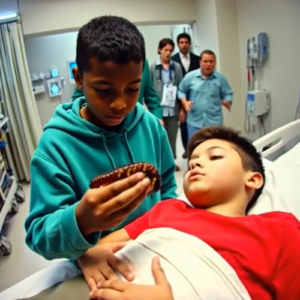
Somehow, he had learned of Elliot’s hospitalization. Perhaps it was curiosity, perhaps empathy—but he felt drawn to the hospital room, past the security and staff, until he quietly stood at the foot of Elliot’s bed.

At first, the staff barely noticed him. But then Jalen’s attention to detail revealed something extraordinary. While the doctors focused on high-tech diagnostics, scans, and lab results, Jalen’s eyes locked onto a tiny obstruction in Elliot’s mouth.
It was a small toy, likely swallowed days before, lodged in a location that had gone completely unnoticed by professionals. “Dad,” Vincent said to the boy as he recognized the urgency, “what do you mean? What’s there?”
“I just… I think there’s something stuck in his throat,” Jalen said simply. His observation cut through layers of technology, protocols, and medical expertise, revealing a simple, human truth.
The medical team responded immediately, carefully removing the obstruction. Almost instantly, Elliot’s breathing normalized.
Monitors steadied, his color returned, and the room that had been filled with tension erupted into cries of relief and joy.
Vincent, tears streaming down his face, embraced his son as he coughed and blinked, life returning to him in fragile but unmistakable waves.
He turned to Jalen, overcome by gratitude. “Thank you,” he said, his voice thick with emotion. “You saved my son. I don’t know how to ever repay you.”
Jalen, with a quiet humility that contrasted sharply with the grandeur of Vincent’s world, shrugged. “I just saw something different,” he replied.
Vincent, moved by the boy’s insight and simplicity, asked, “Anything you need, anything at all. Just ask.”
Jalen’s wish was unassuming, almost poetic in its modesty. “Help my community,” he said. “Help the people who don’t have what I have.”
The words resonated deeply with Vincent. He realized that in saving his own son, a new responsibility had been illuminated: to use his resources and influence to uplift those around him, not just those within his immediate circle. Within weeks, he mobilized significant funds to revitalize Jalen’s neighborhood.
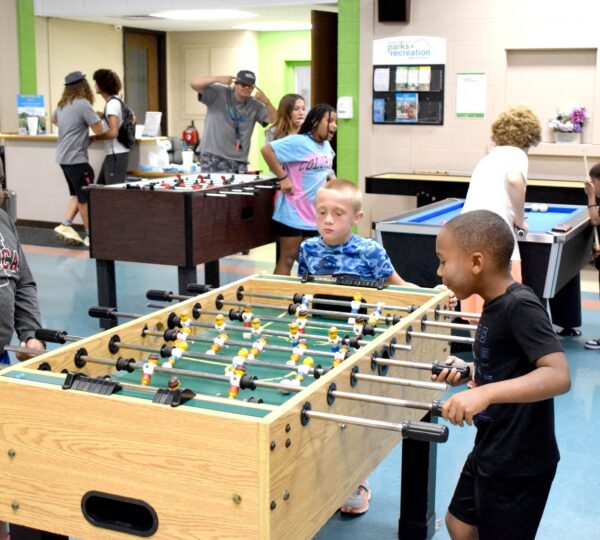
A new community center was constructed, serving as a hub for after-school programs, tutoring, and recreational activities.
Educational initiatives were funded, providing scholarships and mentorship for students who previously had little access to higher education opportunities.
Local medical facilities were improved, ensuring that children in the neighborhood had better access to preventive care and emergency treatment.
What began as a personal crisis transformed into a larger movement of positive change, with Vincent leveraging his position to create tangible impact in ways he had only conceptualized before.
As Elliot recovered, the father-son bond strengthened. Morning routines resumed, but with a renewed depth of understanding and shared experience. Elliot, now aware of both human vulnerability and the potential for kindness, continued to question the world around him.
“Dad,” he said one afternoon while they worked on planting flowers at the community center, “why do some kids have so many things, and others so little?”
Vincent smiled gently, kneeling beside him. “It’s not fair,” he admitted. “But we can’t fix everything. What we can do is make a difference where we can, just like you saw someone needed help, and spoke up.”
The lessons of humility, perspective, and compassion were not lost on either boy. Jalen continued to participate actively in community programs, becoming a peer mentor and symbol of the potential for agency, even among those with limited resources.
Elliot, meanwhile, carried with him a sense of gratitude and responsibility that would shape his worldview for years to come.
The incident became a touchstone for Vincent, a reminder that wealth and influence are most meaningful when deployed to benefit others. It also became a narrative of hope: that even small, overlooked voices can have profound impact.
The story drew attention from local media, highlighting the collaboration between the billionaire and the neighborhood children, and sparking conversations about philanthropy, empowerment, and the often-overlooked potential of youth.
In the weeks that followed, Elliot and Jalen could often be seen together at the new community center, laughing, playing, and helping others.
They had bonded over an experience that neither would ever forget, creating a bridge between two worlds that might otherwise never have intersected.
Vincent watched them, aware that the ripples of one simple act—one child noticing what adults overlooked—had extended far beyond what anyone could have anticipated.